Tag Archive: Jean-Luc Godard


Cool quotes for movie buffs

While working on my soon to be published book on British cinema and identity I accumulated a lot of quotes about films in general.

These are some of my favourites:

Illustration from a 1922 article on “The Romantic History of the Motion Picture”: George Eastman was trying to improve the kodak when he hit on celluloid film
  • “Film is not the art of scholars but of illiterates. And film culture is not analysis, it is the agitation of the mind” – Werner Herzog
  • “The study of the film as a means to human understanding is not a mere intellectual exercise. It is part of a continuing study we have all got to make in our search for harmony in a tortured world.” – Ross McLean, Head, Films & Visual Information Division, Unesco
  • “Marginal cinema is now the only form of national cinema” – Meaghan Morris
  • “The problem is not to make political films, but to make films politically.” —Jean-Luc Godard
  • “If there’s a corridor, there’s a film” – Céline Sciamma
  • “Films that are entertainments give simple answers but I think that’s ultimately more cynical, as it denies the viewer room to think. If there are more answers at the end, then surely it is a richer experience.” – Michael Haneke
  • “Sometimes film needs the room to dream” – David Lynch
  • ‘I’d rather people feel a film before understanding it.’ – Robert Bresson
  • “Film is a highly evocative ideological sphere. It does not reflect its time or society; instead it reinforces, moulds, twists and subverts the many truths of culture.” – Tara Brabazon
  • “The created world must obey its own logic” – V.F. Perkins

THE HITCH-HIKER directed by Ida Lupino (USA, 1953)

mangun “All you need to make a movie is a girl and gun” said Jean-Luc Godard but what did he know?

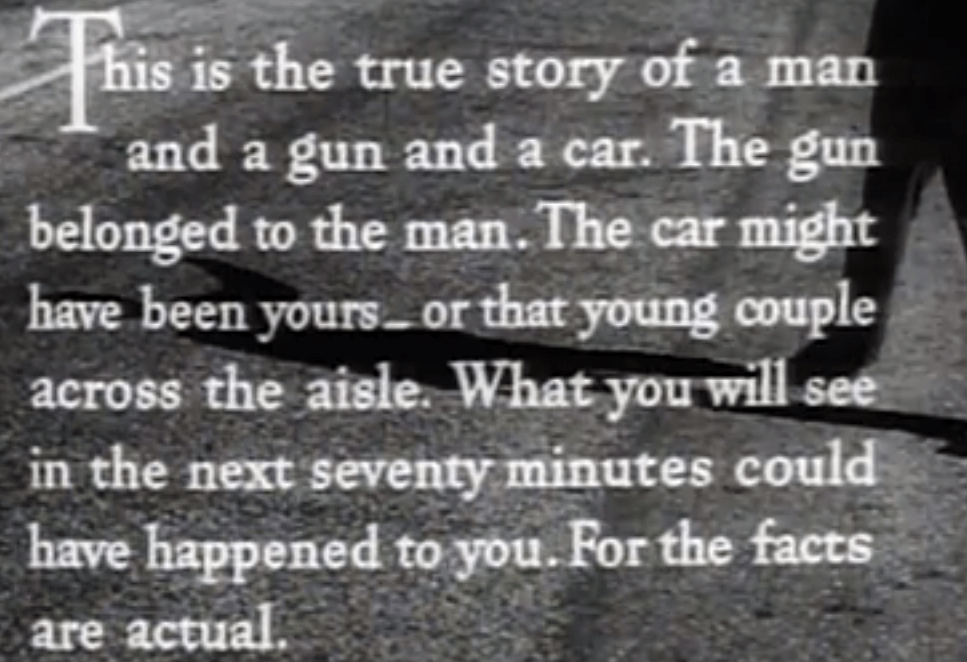
The opening of The Hitch-Hiker says that ‘This is the true story of a man and a gun and a car’ – no mention a girl and aside from the scream (off camera) of the killer’s first victim, women are conspicuous by their absence.

Yet there is the, not insignificant, detail that there is a  ‘girl’ behind the camera since this is the first noir film out of hundreds to be directed by a woman. Continue reading

LE MÉPRIS (Contempt) directed by Jean-Luc Godard (France 1963)

 “Film is strange – show women a camera and they show their behinds”.

This observation by Paul Laval (Michel Piccoli) may be flawed as a universal law of cinema but clearly has an element of truth in the circles Jean-Luc Godard moved in during the sixties.

To prove the point,  the archetype auteur begins the movie with Brigitte Bardot as Camille stretched out languorously on a bed, stark naked, running through an inventory of her body parts to check that Paul, her husband, admires them all – feet, ankles,knees, thighs, buttocks, breasts, nipples, shoulders, arms, and face (mouth,eyes,nose & ears).

Do you think I'm sexy?She could have saved him and us a lot of time by asking the last question first – “Do you love me totally?”

After having given his unconditional approval of her anatomy, he assures her that his love is absolute:  “I love you totally, tenderly, tragically”.

This scene was tagged on at the end when the producers complained that audiences needed to see more unclad shots of Bardot  – suggesting that she wasn’t chosen purely for her acting ability! Continue reading

400 BLOWS FOR FREEDOM

LES QUATRE CENTS COUPS (The 400 Blows) directed by François Truffaut (France, 1959)

TruffautI don’t speak French, but I am reliably informed (by Wiki!) that the original title of this brilliant movie comes from an expression meaning ‘to raise hell’.

To call the 12-year-old Antoine Doinel (Jean-Pierre Léaud) a hell raiser is a bit of an exaggeration. He is disruptive and difficult but he is a good-hearted kid whose transgressive behaviour shows a keen intelligence more than a malevolent spirit.

His rebellion against the soul-destroying school system and oppressive home environment seems a wholly justified quest for a non-institutionalised education that teaches him more than simply how to conform.

We see him playing truant, sneaking into cinemas and embarking on a non too successful career as a petty criminal.

Truffaut’s remarkably assured debut is loosely based on his own life and fulfilled his aim to show adolescence “as the painful experience that it is”. Continue reading

Hitchcock

The BFI poll gets James Stewart in a spin.

Every ten years since 1962 the British Film Institute (BFI) via Sight & Sound magazine has published a list of the fifty greatest movies ever made. This is based on the votes of critics, programmers, academics and distributors.

This decade’s poll sees Alfred Hitchcock’s Vertigo in the top spot, the first time that Orson Welles’ Citizen Kane has not been number one.

When any list like this is published, the first thing I look for is how many of these films I have  seen.

As I write, this totals just 23 so I have set myself a personal goal of seeking out the other 27 over the next few months to see what I have been missing and be in a better position to criticise the critics.

Watch this space. Continue reading