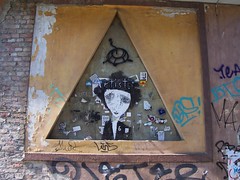
Pagina 27 bookstore, Cesenatico, Italy
How would you define a bookworm?
Most dictionaries will tell you that it is someone who reads a lot but I think it means more than merely being an avid reader.
It isn’t just the love of books, it’s the thought that they are so fundamental to existence that without them you’d go insane or die or both.
The Italian translation is “topo di biblioteca” (a ‘library mouse’) which makes it sound like part of a nasty rodent infestation or else a misanthrope who survives the trauma of the modern world by hiding away in the shelves and shadows of a public building.
These negative connotations are probably a reflection of those who brand these ‘worms’ as ‘freaks of nature’ with their noses forever in a book. “There’s more to life than books” they may think and often say, with the implication that the pen is not mightier than the sword but that actions speak louder than words.
A strong statement for the defence of ‘freaks’ came from Brother Mouzone in HBO’s The Wire when he pointed out that the most dangerous thing in America is “a nigger with a library card”.
For the nation’s leaders, an educated populace is a threat since the lower orders might get ideas above their station. George Orwell knew exactly what he was satirising when he turned the truism that knowledge is power on its head and invented the Big Brother slogan “ignorance is strength” for this is exactly the hegemony that the power brokers use to keep people in their place.
So if you have politicians that read, it’s good, right?

“Gee – you read good!”
Well, yes and no. Certainly, having the bright Barack Obama in the White House is more reassuring than the dumb George Bush.
There’s a famous shot of Bush holding the book My Pet Goat upside down in a children’s classroom. Even if ,as some has suggested, this is a product of Photoshop, the fact that it looks credible speaks volumes. I can visualise Barack reading more than just official circulars (the right way up) than Bush. It doesn’t mean that his politics are always right but it does signify that his brain cells are fully operational; quite a useful attribute for a president.
Meanwhile,in Britain, a recently report in The Guardian picked up on an interview with Lib Dem leader and Cameron collaborator Nick Clegg gave to the women’s magazine Easy Living. In the original link to this piece, it refered to Clegg as a bookworm. The article itself revealed only that he likes to read a few pages of a novel before going to sleep to help him wind down at the end of a busy day. This doesn’t sound like my idea of a true bookworm.
Most of the great books are not going to send you off serenely into dreamland. One of the greatest novels of the last two decades is David Foster Wallace’s Infinite Jest which gets your mind buzzing rather than helping you to calm down.
One of the key themes of Wallace’s masterpiece is dependency. This is something ‘real’ bookworms can relate to since they have an obsession bordering on addiction; the need to read is as urgent as that of a long-term junky’s craving for the next fix. Without these regular ‘hits’ life just feels meaningless; reading fills this emptiness with structure and perspective.
And there’s a world of difference between a wise politician and a crafty opportunist. Clegg is one of the latter breed. He has made a devil’s pact with a Conservative party that is overseeing major cuts in library services. A genuine book addict would help block this state sanctioned hooliganism and be on the front line speaking in support of mice and men.

 With some relief, I have finally come to end of another term of teaching English as a foreign language at Bologna University.
 David Foster Wallace’s commencement address to the 2005 graduating class of Kenyon College has long been a holy text for me; something I turn to when I need to be reminded that learning is so much more than the ability to memorize and regurgitate facts.
 I read Although Of Course You End Up Becoming Yourself – A Road Trip With David Foster Wallace by David Lipsky (