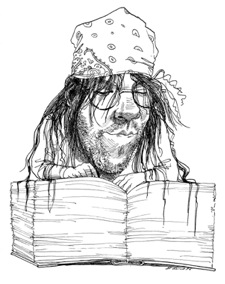
SIGNIFYING RAPPERS by David Foster Wallace & Mark Costello
(Back Bay Books, 2013 – originally published 1990).
“Can blue men sing the whites, or are they hypocrites?” was the surreal and satirical question posed by the Bonzo Dog Band in 1968. In Signifying Rappers, David Foster Wallace (DFW) and Mark Costello are more in earnest when they ask themselves “What business do two white yuppies have trying to do a sampler on rap?”
In both instances, the question could be reframed as ‘What do privileged white people know about the music of disenfranchised blacks?’
Section one of the DFW & Costello’s book is called ‘Entitlement’ and, in it, they seek to convince the readers that they are qualified to analyse rap music despite being of the ‘wrong’ class and color. We learn of their frustration with Punk and other supposedly anti-establishment music which has been appropriated by the mainstream as the acceptable (i.e. unthreatening) face of rebellion.
Rap is lauded as “the first pop genre to countenance a particularly modern American despair, one for which popular music, maybe any popular art, can no longer be a palliative”. This is music which is founded on tension and rage, maintaining a deliberately provocative standpoint so that Public Enemy’s Chuck D advocacy of “killing as a metaphor for excelling” is the type of explosive statement that challenges the liberal values of corporate America.
Rap is described as “a unique U.S. inner-city fusion of funk, technified reggae, teen-to-teen ‘hardcore’ rock, and the early ’70s poetry of the black experience of Nikki Giovanni, the Last Poets,etc” . Part of its radicalism is that “anyone with a larynx can rap”; you don’t need money or musical expertise, all you need is to have something to say.
I read this book now as a historical document not just to learn about a cultural phenomenon but for an early example of DFW’s published works. It is unlikely that it would have been republished if Wallace were still alive today. Since his tragic suicide in 2008 there has been a surge in demand for his writings and for more details of his short life.
The publishers are clearly of the opinion that people will read it for the text (i.e. DFW’s writing) rather than for furthering their musical education. Why else would they have cut the appendices from the original which included a discography of artists/tracks quoted? (This includes the song which gives the book its title – Signifying Rapper by Schooly D).
You won’t find many examples of DFW’s literary genius but you do get a sense of his disillusionment with straight society that is such an essential part of his fiction and journalism. We perceive his deep sadness that the American dream has become so debased that the concept of liberty is now synonymous with the quest for fame and/or the accumulation of material wealth. He writes: “surely freedom can’t be just the wherewithal to buy and display …..more than the Pursuit of Yuppiness” and he makes a telling distinction between “what the electric voices say you must have and what the human voices say you may not”.
The book is dedicated to the greatest music writer of them all, Lester Bangs and it self-consciously draws parallels with postmodernist ideology and regards the inflammatory lyrics as “real poetry that means something”. It is written in the form of a ping-pong conversation between the two young opinionated writers with chapters divided between M and D.
Both agree that Rap Music, in its purist form, has a unique capacity to hold up mirror to their world rather than serving as an abstract adjunct. It is a notion which may seem dated from a cultural perspective but this slim volume is still worth reading for passionately expressing the belief that any form of modern art should be more than just another consumer durable.

 Nowadays it often seems increasing redundant, even prudish, to claim that there’s anything wrong with pornography.


 I read this story to plug a gap in my literary knowledge and as background research as part of my re-reading of David Foster Wallace’s Infinite Jest. The style and experimentation certainly helps put Wallace’s magnum opus into context.