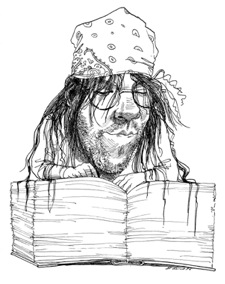
Comedian Eddie Izzard once said that his dyslexia meant that instead of being widely read he was ‘thinly read’. You would think that this would exclude him from James Wood’s celebration of bookwormery but Wood once commented that “I’m generally in favor of reading a bit less and knowing it deeply.”
His deep reading documented in this slim volume is applied to a broad range of fiction from The Bible to Beatrix Potter.
Because his chief loves are classic authors like Austin, James,Flaubert, Chekhov and Tolstoy, Wood has been accused of being old fashioned in his analysis. The charge is misplaced because Wood certainly doesn’t exclude contemporary voices. This, after all, is the critic who coined the great term ‘hysterical realism’ in a review of Zadie Smith’s ‘White Teeth’ in The New Republic in 2001.
Wood may have reservations about David Foster Wallace’s fiction but he understands very well how his hyper-modernist style works: “the novelist’s job is to become, to impersonate what he describes, even when the subject itself is debased, vulgar, boring. David Foster Wallace is good at becoming the whole of boredom”. Which is not to say that DFW is boring (perish the thought!) just that he can write about boredom like no other.
Wood’s stated objective is to get readers “to think in a writerly way” and to this end his own writing is free of academic jargon, or as he puts it in an introductory note: “Mindful of the common reader, I have tried to reduce what Joyce calls the ‘true scholastic stink’ to bearable levels”.
He therefore writes in plain English and gives concrete examples served up in 123 bite sized numbered paragraphs in an admirably concise 187 pages. His brow may be high but his writing is refreshingly free of the self important wankery that burdens most lit-crits.
There are valuable tips for both readers and writers which he presents in a lyrically way, for instance at one point he comments that “good prose….knows when to withdraw,like a good valet, from superfluous commentary”.
“The book is called ‘How Fiction Works’ but might easily have been called ‘Why Fiction Matters’. He argues passionately that reading makes us better people: “Literature makes us better noticers of life; we get to practice on life itself; which in turn makes us better readers of detail in literature; which in turn makes us better readers of life”.
This book is highly recommended for all true book addicts.

 Infinite Jest was written over two decades ago but is still remarkably topical in an age where the line between entertainment and ‘real life’ is increasingly blurred.