Tag Archive: Tate Modern


The final peer-assessed assignment for Coursera MOOC on Andy Warhol run by Edinburgh University was to write between 650-750 words to describe, discuss and evaluate a piece of Warhol’s work. This is what I wrote:

Warhol Electric Chair 1964

Andy Warhol always struck the pose of an artist who chanced upon an image in much the same way that a child might discover a striking picture in a glossy magazine.

Yet a sparse and evocative photograph of an electric chair hardly seems to be a random choice. A real photograph carries a weight of fact, even though it can be deciphered in various ways.

Warhol’s image was adapted from a 1953 photograph taken at Sing-Sing Gaol in New York and produced in 1964. It was presented to the Tate Modern in London by Janet Wolfson de Botton in 1996. The medium is screen print and acrylic paint on a canvas sized 562 x 711 mm.

Warhol subsequently re-used the photo for a series of fourteen prints in different colour combinations but this particular one has a muddy, minimalistic colour scheme almost as if the picture has deteriorated with age. An unwitting viewer might therefore mistake it for a torture instrument from a bygone era rather than a killing machine which is still in use in many parts of the USA, albeit on a reduced scale. Continue reading
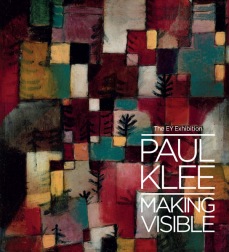
PAUL KLEE WALKS THE LINE

kleevisibleOne of the highlights of my short trip to London was the Paul Klee retrospective at the Tate Modern which runs until 9th March 2014.

I’ve always loved Klee’s work but didn’t know much about his life and hadn’t previously seen an exhibition devoted to his work.  Displayed in chronological order, it  gives a fascinating insight into one of the towering geniuses of 20th century art.

In an entry in his diary from 1914 Klee wrote “color and I are one” yet it is evident that draftsmanship came first.  In his class at the Bauhaus he instructed students that “drawing is taking a line for walk“.

The gallery’s audio commentary emphasises Klee’s “iinfallible logic” and “structural rigor” which contrasts with the emotional power and imaginative flow of his art.

Klee recognised humankind’s potential for liberty yet was not blind to the fact that hurdles had to be overcome to unlock the creative floodgates : “half-winged, half imprisoned – this is man”, he wrote. Continue reading

Tate Modern
These Associations – Turbine Hall, Tate Modern.

In visiting the Tate Modern for the Edvard Munch exhibition, I chanced fortuitously upon a very different use of the gallery’s space.

Berlin-based artist Tino Sehgal was commissioned by the Tate to utilise the Turbine Hall for a work entitled ‘These Associations’ which runs until October 28th, 2012.

The piece consists of what the gallery describe as “an assembly of participants”; around 70 men and women who work four-hour shifts.

They are paid a modest sum of between £8 and £9 per hour so I think it’s safe to say that the primary motivation isn’t financial.

Sehgal calls this work a ‘constructed situation’ rather than adopting the more pretentious and off-putting term of ‘performance art’.

Continue reading

Munch between clock and bed

One of Edvard Munch’s final paintings – Between The Clock And The Bed – presents a chilling self portrait of an artist who knows death is close at end.

As you exit through the gift shop at the Tate Modern in London after witnessing the exhibition Edvard Munch: The Modern Eye , the recurring image that greets you on T-shirts, books, postcards and calendars is the Norwegian artist’s most famous work – The Scream.

Somewhat bizarrely, this famous image of alienation is one that you will not see in the exhibition itself. The Tate show, curated by Nicolas Cullinan, seeks to present a fresh perspective on Munch’s work from 1900 onwards and showing that he should be viewed as a more complicated and innovative modern artist rather than merely as the creator of a single iconic work.

The tag line for the show is “if you think you know Edvard Munch, think again”. Continue reading

“Mother and Child Divided”

‘It’s amazing what you can do with an E in A-Level art, a twisted imagination and a chainsaw.’ – Damien Hirst acceptance speech after winning the Turner Prize 1995.

In Channel 4’s entertaining documentary about Hirst’s current retrospective at London’s Tate Modern the controversial artist looked disconcertingly like Phil Collins and was keen to show that he’s still an ordinary diamond geezer.

His obsession with death is obvious from his works although he revealed that he has never seen a dead body of anybody he was close to.

Presenter Noel Fielding established to no great surprise that Hirst does not believe in God but holds that “all art is about immortality” and he said “my belief in art is religious”.

He has moved on from dead sharks, sheep and cows and currently favours butterflies which symbolise hope because they look alive even when they’re dead.