Tag Archive: Ravenna


The line between madness and sanity is a fine one at the best of the times.

The nature of true creativity means constantly walking a tightrope between these two states of being.

This delicate and disturbing balancing act is reflected in the subtitle of the fascinating yet disquieting Borderline exhibition at Ravenna’s Museo d’Arte della Città (MAR) :  ‘Artisti tra normalità e follia (Artists between normality and insanity). Continue reading

SOUND, VISION AND SOFT TOYS

Transmissions VI festival in Ravenna  14th March 2013 – Teatro Rasi
Robert Aiki Aubrey Lowe (Lichens) + Charlemagne Palestine

Image from Lichens show at Ravenna

Edgard Varèse famously defined music as ‘organised sound’ and influential artists like Le Monte Young and John Cage staked their reputations on the belief that everything we hear can be classified as ‘music’.

This no limits philosophy was followed by the two American musicians who performed in Ravenna on the first day of the Transmissions Festival which follows a broad theme of transcendence. They belong to different generations but both refuse to be constrained by anything resembling conventional song structures.

Robert Aiki Aubrey Lowe

Chicago’s Robert Aiki Aubrey Lowe is perhaps easiest to classify as his electronica/ ambient works contain echoes of Bowie’s Berlin period (Low especially) and also reminded me of early Tangerine Dream albums like Phaedra or Rubycon.

He uses a delay pedal to build a one-man chorus of banshee-like falsetto mantras against a backdrop of electronic drones and digitally generated beats. This, one imagines, has a spiritual purpose yet suggests strange ritualistic rites rather than conventional religious ceremonies. During the 45-minute set, he is in semi darkness so, aside from the music, the focus is directed to a large screen which projects eye/fish-shaped images in garish psychedelic colours.

Charlemagne Palestine is harder to pigeonhole. Now in his late 60s, he is commonly spoken of in the same breath as his contemporaries like Steve Reich, Phillip Glass and Terry Riley. It’s easy to understand why after  he played what I took to be an abridged version of his  Strumming Music first recorded in 1974.  However, this eccentric show was more like a one-hour piece of performance art than a demonstration of minimalism.

Charlemagne Palestine adds soft toys to the stage set.

You knew it was going to be unusual from the fact that, before playing, he carefully decorated the stage with soft toys and scarves pulled from two red suitcases.

He began by walking around the auditorium making a high-pitched sound by rubbing his finger around a glass of cognac. To this he added some wordless moans. Then, on stage,  he held two teddy bears up to microphone for them to chant “We like to sing” in harmony, though they were very slightly out of synch.

Teatro Rasi is a 13th century building that used to be a church and with a mobile mic-headset Palestine wandered to the back of the stage to make full use of its ecclesiastical acoustics. The sub-human chant he produced sounded like something off David Lynch’s Crazy Clown Time.  The weird effect was compounded when he retrieved a dense mass of noise, containing indistinguishable voices, from his MacBook. He concluded with a similar out of synch trick, this time with two musical toys.

During all this no-one in the bemused audience seemed sure whether to clap or make a discreet exit and there was no applause until the very end.

It was one of the most bizarre performances I’ve ever witnessed though on reflection it perfectly exemplified  the definition of music as propounded by Varèse et al – while it looked chaotic, there was method, and organisation, within the madness.

Mark Pilkington (photograph by Etienne Gilfillan)

The inaugural event at the four-day Transmissions VI festival in Ravenna was a talk by Strange Attractor Press’ publisher, writer and editor Mark Pilkington entitled ‘From The Akashic Jukebox: A Pop History of British Magick: 1888 – 1980’.

The esoteric, historic theme of this address was fully in keeping with the Strange Attractor philosophy of seeking out neglected cultural and anthropological trends from the past and connecting them to the modern world.

The little I have read about Aleister Crowley, which I admit is not much, has led me to conclude that he was a bit of a dickhead. Pilkington did nothing to dispel this assumption, describing him as being more famous as a hell-raiser than as a thinker and saying that he was like the evil twin of his contemporary Robert Baden-Powell.

While Baden-Powell was promoting the wholesome, though borderline fascist, boy scout movement, Crowley dabbled in the black arts to the point that his own mother nicknamed him The Great Beast. He founded his Thelema ‘religion’ based on the (un)ethical code ‘Do what thy wilt’, an invitation to excessive self-indulgence if ever there was one.

The ‘K’ was used to signify that his brand of ‘magic’ had nothing in common with the Hogwarts variety. Pilkington observed that the K also stood for Kteis, the Greek word for vagina, which says a lot about what track Crowley’s mind was on. Continue reading

EDCMOOC WEEK 3 IMAGE ACTIVITY

In week 3 of the E-Learning & Digital Cultures MOOC .  students have been invited to create an image that represents any one of the themes encountered in the course so far.

I’m not entirely sure if cropping my Flickr photos counts as being sufficiently creative but I’ve been going through my past shots of graffiti and street art looking picture that fit this category.

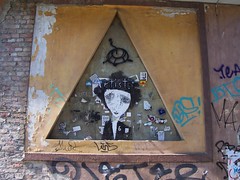
My favourite is this one I took in a side street in Ravenna, Italy which I think serves to counter balance the dystopian notion that machines are taking over our world.

if robots are invested with human characteristics, perhaps they can feel lonely too.

This yellow bot certainly looks isolated and in need of love.

Perhaps the true fear we should address is not  that machines are becoming too powerful but that human beings are too distrustful of the idea that technology can be a force for good.

ALT-J LIVE: NO SHOCKS & NOT MUCH AWE

Alt-J Alt Text

Alt-J with their Mercury Prize

ALT-J LIVE  AT THE BRONSON CLUB, RAVENNA 28th November 2012

After accepting this year’s Mercury Prize, the members of Alt-J  voiced confidence that the well-deserved award would be a blessing rather than a curse.

Previous winners like M People and Gomez may have largely failed to live up to high expectations but the four young graduates from Leeds insisted that they had plenty of material to ensure they can maintain the momentum of their debut album.

However, there was no evidence of this at the band’s sell out show in Ravenna.

One must assume that none of these new songs are ready to be aired in public. Continue reading