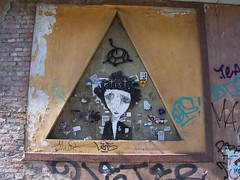
Transmissions VI festival in Ravenna 14th March 2013 – Teatro Rasi
Robert Aiki Aubrey Lowe (Lichens) + Charlemagne Palestine

Image from Lichens show at Ravenna
Edgard Varèse famously defined music as ‘organised sound’ and influential artists like Le Monte Young and John Cage staked their reputations on the belief that everything we hear can be classified as ‘music’.
This no limits philosophy was followed by the two American musicians who performed in Ravenna on the first day of the Transmissions Festival which follows a broad theme of transcendence. They belong to different generations but both refuse to be constrained by anything resembling conventional song structures.

Robert Aiki Aubrey Lowe
Chicago’s Robert Aiki Aubrey Lowe is perhaps easiest to classify as his electronica/ ambient works contain echoes of Bowie’s Berlin period (Low especially) and also reminded me of early Tangerine Dream albums like Phaedra or Rubycon.
He uses a delay pedal to build a one-man chorus of banshee-like falsetto mantras against a backdrop of electronic drones and digitally generated beats. This, one imagines, has a spiritual purpose yet suggests strange ritualistic rites rather than conventional religious ceremonies. During the 45-minute set, he is in semi darkness so, aside from the music, the focus is directed to a large screen which projects eye/fish-shaped images in garish psychedelic colours.
Charlemagne Palestine is harder to pigeonhole. Now in his late 60s, he is commonly spoken of in the same breath as his contemporaries like Steve Reich, Phillip Glass and Terry Riley. It’s easy to understand why after he played what I took to be an abridged version of his Strumming Music first recorded in 1974. However, this eccentric show was more like a one-hour piece of performance art than a demonstration of minimalism.

Charlemagne Palestine adds soft toys to the stage set.
You knew it was going to be unusual from the fact that, before playing, he carefully decorated the stage with soft toys and scarves pulled from two red suitcases.
He began by walking around the auditorium making a high-pitched sound by rubbing his finger around a glass of cognac. To this he added some wordless moans. Then, on stage, he held two teddy bears up to microphone for them to chant “We like to sing” in harmony, though they were very slightly out of synch.
Teatro Rasi is a 13th century building that used to be a church and with a mobile mic-headset Palestine wandered to the back of the stage to make full use of its ecclesiastical acoustics. The sub-human chant he produced sounded like something off David Lynch’s Crazy Clown Time. The weird effect was compounded when he retrieved a dense mass of noise, containing indistinguishable voices, from his MacBook. He concluded with a similar out of synch trick, this time with two musical toys.
During all this no-one in the bemused audience seemed sure whether to clap or make a discreet exit and there was no applause until the very end.
It was one of the most bizarre performances I’ve ever witnessed though on reflection it perfectly exemplified the definition of music as propounded by Varèse et al – while it looked chaotic, there was method, and organisation, within the madness.
Related articles
- Strumming Music (1974). Charlemagne Palestine /well suited for repetitive music/ (rgable.typepad.com)
 It’s a fair bet that any solo acoustic guitarist on the indie/underground circuit will at some time or other be compared to John Fahey. Montreal based Harris Newman made the perceptive comment that since Fahey experimented with so many different styles and “did everything at one time or another”, anybody who plays instrumental guitar could conceivably be compared is him.