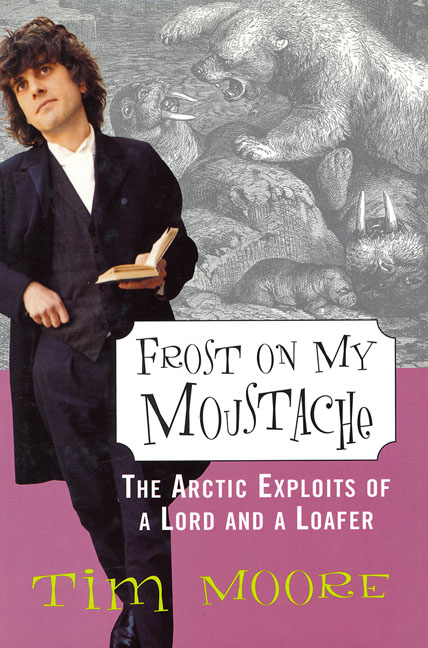
FROST ON MY MOUSTACHE by Tim Moore (Abacus, 1999)

I don’t read that many travel books but,if Frost on my Moustache is anything to go by, this is my loss.
The young Englishman’s Bill Bryson-esque account of a two month journey to the Arctic Circle in 1997 by boat and bike begins with an over long prologue, ends in an anti-climactic manner but,in between, contains plenty of very funny descriptions of his, often less than pleasurable, experiences.
The journey from Scotland to Iceland and then to the northernmost tip of Norway follows that of Lord Dufferin; an account of which Moore discovered in a book entitled Letters From High Latitudes first published in 1856 which his Icelandic wife had given him.
Wikipedia says that this book was noted for its “irreverent style, lively pace and witty commentary” so you can understand why Moore was attracted to it and why he was prompted to write an updated version.
Having lost his job with Teletext and finding himself at a loose end, Tim Moore was looking for something to shake himself out of a rut.
Though by no stretch of the imagination can he be described as a hardy traveller, he wants a break from his idle, sedentary lifestyle : “my motivation in replicating his [Dufferin’s] voyage encompassed a vague desire to achieve something notable for once”.
From the outset you are struck by Moore’s ornate, extravagant and self deprecating style. This for example, is how he describes his lack of adventurous spirit prior to undertaking this arctic trip: “it was impossible to find any residual spark of pioneering grit in the shrugging sneer that besmirched my bathroom mirror”.
He seems only moderately curious about Iceland or Norway; it’s something in himself he wants to discover. What is quickly apparent is that Moore’s preparations are woefully inadequate in terms of both training and equipment.
For the bicycle journey across Iceland (Dufferin and his team were on horseback), he is accompanied by his brother-in-law, Dilli who doesn’t seem to be much of an expert explorer either. Moore introduces one camping story thus: “Two incompetents pitching a tent in the rain is never going to be a brief or noiseless procedure”
On top of this, Moore suffers terribly from sea sickness, has a fear of heights and an innate aversion to any form of extreme activities. This makes for a voyage riddled with discomfort and embarrassment although with the consolation that recounting these experiences makes for a highly entertaining read.
The dry English humour combined with a heightened formality is very effective and often hilarious, as in this description of preparing to bathe in one of the outdoor hot pots
“People over the age of 60 are generally the only Icelanders with a less than fluent grasp of English, which was particularly unfortunate in this case as it rendered the gesticulations – pointing at my trunks with one hand and miming a vigorous frottage with the other – open to a disturbing variety of interpretations”
What this man is trying to impress upon Moore is the need for scrupulous cleanliness before taking to the waters. Misunderstandings like this make for a rich source of humour.
The title itself is the punchline to a joke in dubious taste about an Eskimo whose car breaks down while driving across the Tundra. A mechanic declares “Look like you’ve blown a seal, mate” to which the Eskimo replies defensively “No, it’s just frost on my moustache”. This joke goes down like a lead balloon with non native speakers who, not understanding the double entendre of ‘blowing a seal’ fail to appreciate the bawdy humour.
If you’re looking for detailed comparative descriptions of the landscape or a rose-tinted perspective on these Scandinavian countries, you are in for a disappointment. His verdict on Reykjavik is that it “is not lovely” while Norway is summarised pithily as being “like Iceland but with trees and a summer”.

Lord Dufferin as a young man.
As the journey unfolds, things don’t always go as he’d hoped. There’s an abortive trip to the volcanic island of Jan Mayen and he ends up at the “plainly horrid” Spitzbergen.
Moore regularly dips into the book that inspired it, quoting passages and comparing how the Lord’s journey compares to his Loafer’s imitation. He concludes that Dufferin is something of a bully and a braggart so comes to identify more with his gloomy and pessimistic valet named Wilson. This was a man who in appearance resembles boxing tycoon George Walker and, in character, put me in mind of the dour and fatalistic Frazer in Dad’s Army.
By the end he is happy to return to his life of loafing with his wife and family in London. He may not have been mentally enriched or physically fulfilled by his adventures but he achieved the objective of making a good book out of it.
******************************************************************
One of the chief reasons for reading this book was to continue my ongoing research about all things Icelandic in preparation for a long postponed trip to the land of fire of ice next year. So here is what I learned about Iceland and Icelanders:
• no Icelander owns an umbrella and they are reluctant to concede that the weather is ever bad.
• they are obsessed with purity and by what people think of them; their fierce independence borders on arrogance.
• they “adopt a highly ‘traditional’ stance to life choices such as vegetarianism and homosexuality”.
• three-quarters of the country’s wealth derives from fishing.
• 53% of the population believe in elves.
• “more books per capita are read and written in Iceland than anywhere else in the world”.
• “consumer crazes arrive and are instantly taken up by the entire population”.
• .visitors “are socially obliged to overdose on caffeine”.
• “the Icelandic swimming pool is perhaps the nation’s finest institution”
Any readers who are from Iceland or think they know something that Tim Moore does not, feel free to take issue with any of the above and/or tell me what you think I ought to know.

 After writing relatively conventional novels, the Norwegian author, Karl Ove Knausgaard declared, as he approached the age of 40, that he was sick of fiction.