RUSSIAN ARK directed by Alexander Sokurov (Soviet Union, 2002)
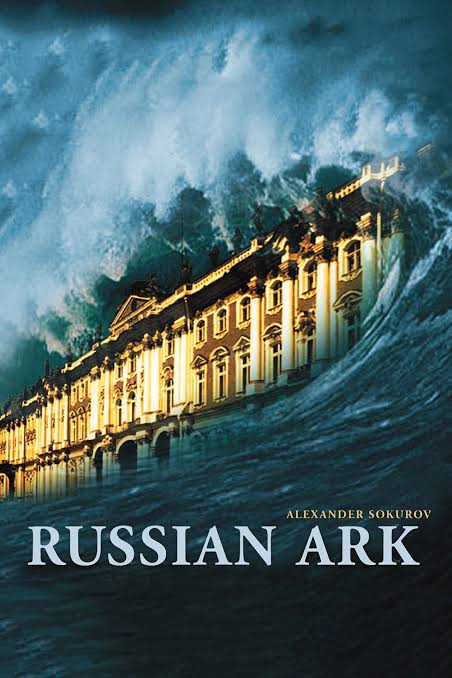
Russian Ark is a historic film about history. It was filmed in the Winter Palace of the State Hermitage Museum in St. Petersburg.
What makes it unique is that it consists of a single tracking shot. Sound, and visual effects, were added in post-production but there are no edits in the 96 minute movie. It took four years to develop but the final preparation and filming had to be done within an extremely tight time schedule. The crew had only 36 hours to prepare the museum in readiness for the actual shooting which had to be completed in one day with only four hours of existing light.
A team of eight were involved in the shooting headed by German cinematographer Tilman Büttner and was made possible by recent advances in film technology. Without the relatively lightweight Steadicam, the equipment needed would have been too heavy and unwieldy to carry around for an hour and a half without a pause.
The floating narrative is built around a dialogue between an off-screen ghost/spy and a European; a 19th century French Marquis. We follow the diplomat (played by Sergei Dontsov) as he passes from room to room to give us a tour of the gallery and in the process he visits episodes from 300 years of Russian history. There are scenes with Peter The Great, Catherine The Great, Tsar Nicolas I & II and the film even brings us right up to date with a cameo role for the museum’s current director Mikhail Piotrovsky.
Solurov says: “I wanted to try and fit myself into the very flowing of time, without remaking it according to my wishes. I wanted to try and have a natural collaboration with time, to live that one and a half hours as if it were merely breathing in…and out. That was the ultimate, the sole artistic task”.

The European visitor makes spiteful and sarcastic remarks about Russian art and culture which Sokurov says was intended to show the gulf of understanding between Russia and Europe.
At one point the invisible spy/narrator says: “Everyone can see the future, no-one remembers the past”. For my part, it is not a case of a poor memory but of ignorance. I know very little about Russia’s history so I’m sure that the significance of most of the references to historic events and personalities passed me by.
What was clear, even to me, is that the film shows a passing era with the monarchy on the brink of being overthrown by the coming revolution. This is marked by a closing scene of the ostentatious elegance with the last great ball of 1913.
The final shot is of ocean waves immediately outside as if the museum is a floating vessel, an ark of culture on a voyage though time.
In many ways the documentary about the making of the movie, In One Breath (which can be seen in five parts on You Tube), is every bit as fascinating as the movie itself. Some of the facts and figures give a flavour of the epic scale of the project. The movie provided employment to:
- 22 assistant directors
- 65 costume designers
- 50 makeup artists
- 3 orchestras
- over 50 electricians
- 867 trained actors
- over 1,000 extras (transported in 10 buses)
All this combines to make a spectacle that needs to be appreciated in the cinema (I watched it on my laptop!) and whatever you think of its cinematic merits, there is no doubt that it is a dream movie for historians and statisticians.