Tag Archive: Nazism


Son Of Saul: humanity vs barbarism

SON OF SAUL directed by Lázió Nemes (Hungary. 2015)
220px-son_of_saul_28poster29

How much of the horror of the holocaust can you stand to watch?

Newsreel footage can turn us all into passive voyeurs to humankind’s capacity for evil. On the other hand, however noble the intentions, turning history into cinema can reduce Nazi atrocities into entertainment.

Lázió Nemes’ remarkable debut avoids both pitfalls. You are never in any doubt about the barbarism at the heart of the story but the camera never dwells on the details. Continue reading

M directed by Fritz Lang (Germany, 1931)

There’s a never-ending debate about the extent to which on-screen violence desensitizes viewers. While it can easily be argued that many splatter movies are lacking in any moral compass, in their own twisted way they are a reflection of the society we live in.

The representation of the serial killer as a symbol of humanity at its most depraved has, to my mind, reached saturation point. I reach for the off switch, not out of disgust but through boredom.

Although made when silent movies were still the norm, Fritz Lang’s first ‘talkie’ is remarkably modern in its stylised atmosphere and for daring to adopt an ambiguous , and less melodramatic, treatment of the subject.

If M was made today, the strong likelihood is that it would be far bloodier and that the level of psychological suspense would be cranked up higher.  As it is, we don’t see any brutality and the murderer’s identity is never in any doubt.

Fritz Lang

Fritz Lang uses the shocking story not to get inside the mind of the child murderer, but to expose the kind of society that produces such horrors. It is no coincidence that it was made in Germany at a time when Nazism was taking a grip on the nation.  Lang’s largely misanthropic view of the world is emphasised by the extensive use of unflattering close-ups and the shadowy, noir atmosphere.

In seeking to solve the series of murders, the police desperately look for clues among the criminal underworld. These seedy mobs are frustrated by the way their  activities are restricted while the killer is still at large. Their resolve to find the man responsible is driven by self-interest rather than by any sense of moral duty .

When they catch him, the clamour for a summary execution is prompted by a rabid desire for vengeance and their call for blood is echoed by the mothers of the victims.

Lang takes a bold, and still unfashionable, line by giving voice to a man ( a lawyer?) who argues that despite the heinous nature of his crimes, the guilty party has the right to a fair trial.

Peter Lorre plays Hans Beckart as a tortured figure driven by an uncontrollable instinct to kill. The movie does not expect the audience to have any sympathy for this homicidal maniac; rather it simply questions whether succumbing to the animal urge to snuff out his life reduces ‘sane and rational’ human beings to the same level as such monsters.

The film’s final message is not a plea for justice but a warning to mothers to take more care of the children.

DJANGO’S UNCHAINED VIOLENCE

DJANGO UNCHAINED directed by Quentin Tarantino (USA, 2012)

The men (and handful of women) who commit murder, behave savagely or revel in brutality have deep-rooted problems that are not triggered solely by exposure to the wrong kind of entertainment. This makes it all the more bizarre that the premiere of Django was delayed by the Weinstein Company in the wake of the school shootings in Newtown, Connecticut.

Both Tarantino and Samuel L.Jackson publically criticised this decision and the director was equally disdainful of Krishnan Guru-Murphy’s puritanical line of questioning in a recent Channel 4 interview.

Django Unchained is without doubt a violent movie but it is wildly misplaced to regard it as just a tasteless or gratuitous bloodfest. It borrows from exploitation-movies but it is far too intelligent and knowing to be treated as a common or garden splatter movie.

The scenes of cruelty and killings can even be justified in view of the subject matter and are surely mild compared with the actual treatment handed out to slaves in America.

Continue reading

WAITING FOR THE MAN

L’UOMO CHE VERRA’ directed by Giorgio Diritti (Italy, 2009)

http://www.slowcult.com/wp-content/gallery//2010/02/luomo-1.jpgIt would have been easy to dramatise the tragic real life events at Marzobotta near Bologna in a sensationalist and exploitative manner, transforming human tragedy into crass entertainment. Instead, the story of the victims is handled with great sensitivity and humanity without glossing over the full-scale of the atrocity.
In 1944, Nazi soldiers massacred 770 people in this small farming community, an act of barbarism that beggars belief. It illustrates that Hitler’s executioners did not confine themselves to the slaughter of Jews but were prepared to slaughter any who dared stand in opposition to Fascism.

Diritti doesn’t claim that his cinematic rendering is historically accurate and it even includes the usual disclaimer at the end that any similarity with  persons living or dead is entirely coincidental. Continue reading

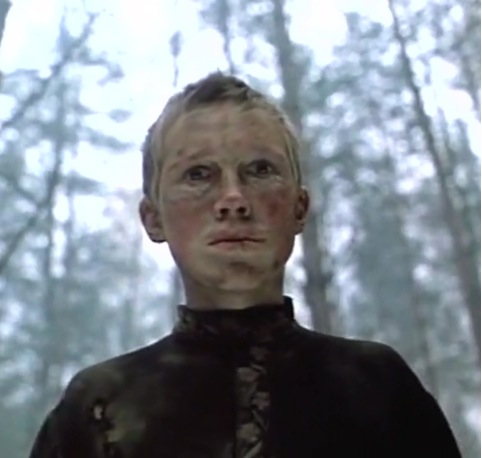
COME AND SEE directed by Elem Klimov  (Soviet Union, 1985)

The original title of this movie was Kill Hitler  which doesn’t win points for subtlety but makes the director’s point of view crystal clear.

By the end our young hero shoots at a framed picture of the Führer and each shot coincides with a newsreel sequence played backwards. History is wound back to before the Hitler’s birth; the dream being that Nazism would not have existed without his leadership.

Hitler is the personification of evil yet the fact that there were so many willing accomplices to the fascist atrocities reveals the sad truth that human wickedness never begins or ends with just one man.

Scenes in the movie of German soldiers laughing and joking as they carry out unspeakable acts highlights the depths of depravity human beings are capable of.  You only have to see the recent footage of American soldiers pissing on the bodies of Iraqi corpses to realise that war legitimizes this descent into barbarism. Continue reading