THE ART OF ASKING by Amanda Palmer (PIatkus Books, 2014)
This book is part memoir, part manifesto and part egocentric vanity project.
Amanda Palmer is a performance artist. She has been a human statue, a stripper and is best known as the lead singer of The Dresden Dolls who, in their early years were, in her own words, “a punk-cabaret duo specializing in tear-jerking seven-minute songs with drum solos”.
The manifesto part, is her fervent belief that artists, and by extension all human beings, need to learn that there is no shame in asking for help when you need a place to sleep or money to finance projects.
The experiences she recounts are proof that this can work. The most dramatic example is a Kickstarter campaign to fund an album. She set a relatively modest target of $100,000 but eventually raised a record-breaking $1 million. This level of success was not without its critics. She has been labelled a “self-serving, greedy, superficial attention whore” but is thick-skinned enough to overcome such unmerited slurs. Continue reading →
Neil Young says he’s not an audiophile but his Pono music device is surely destined to get most of the early adoration from discerning hi-fi enthusiasts.
Young’s pledge is that with he is saving a dying art form but lossy music and streaming sites are what most consumers have grown up with and persuading the masses that they need another format and dedicated player is a hard sell.
On top of that, the failure of the Super Audio CD (SACD) does suggest that there is at best only a relatively small market straining at the leash for high-resolution digital audio. Having said that, the huge success of the Kickstarter campaign means that Shakey’s brainchild should not be dismissed out of hand.
If all you want to listen to are ‘classic’ albums by established artists then Pono might be more appealing. But even though I love stuff like Highway 61 Revisited or Dark Side Of The Moon, these are not records I go back to that often. I’d much rather hear something new than go on some nostalgia trip. It remains to be seen how much of Pono’s music store will cater for marginal tastes.
Nevertheless, the video promo for the device does make me curious to hear what all the fuss is about. A series of star names are full of superlatives after having taken a ride in one of Young’s vintage automobiles which is presumably fitted with a state of the art sound system. Though you ought to take what Mumford & Sons say with a pinch of salt, you begin to think there may be something in the Pono to when the likes of Beck, Rick Rubin and Gillian Welch sing its praises.
I don’t for a minute doubt Neil Young’s sincerity but my gut failing tells me that it is a product that has arrived too late in the day. I regard myself as more than a casual listener but even so my musical addiction is already well catered for by web services such as Spotify, Bandcamp or Soundcloud. When on the move I’m happy with my iPod or smart phone and am prepared to accept a poorer sound for the convenience.
The proof of the Pono pudding will be in the hearing but I seriously doubt it will the game changer some are claiming.
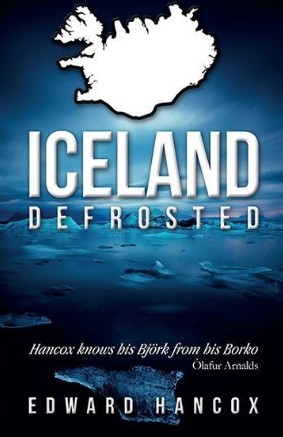
ICELAND, DEFROSTED by Edward Hancox (SilverWood Books, 2013
If I was commissioning a book about Iceland, I would want something that was more than a standard check list of places to visit and things to do.
I’d want a book that told me exactly why this small duck-shaped country is so unique, stunningly beautiful and how it comes to be blessed with the knack of producing so many stunning musicians.
And lo and behold, I don’t need to commission anything because Edward Hancox has just published almost exactly the book I’ve been looking for. The book was crowdfunded through kickstarter and hit the target in just six days, as clear an indication as any that I am not the only one looking for a book on this topic.
To further demonstrate that he and I were on the same wavelength, I had just written a review of the album by Samaris (yet another great new band from Reykjavik) and then found that Hancox had published an interview with the teenage trio on his website.
As if this wasn’t enough, he is also, like me, from the English Midlands – Shropshire to be precise (I’m from Lichfield in Staffordshire).
Being in his early 30s, Hancox is more than 20 years younger than me but, heck, you’re only as young as you feel, anyway, right?
‘Heck’, by the way, derives from Icelandic and one of the authors favourite crossover words ; another is berserk. I didn’t know the etymology of either – geyser was the only Icelandic word I thought I knew.
The book begins in Reykjavik and then follows the author as he takes us on a circuitous route around the rest of the country. We follow him being awestruck by glaciers that still cover 11% of Iceland’s surface, keeping a safe distance from some of the thirty one active volcanoes and taking frequent stop-offs in the hot pots, luxuriating in the numerous naturally heated pools. Throughout, he nurtures a dream of one day witnessing the elusive Northern Lights.
There’s clearly plenty in Iceland to satisfy the most discerning sightseer, but the recurring message of the book is that it is warmth and hospitality of the people that keeps him coming back for more. While the first impression is that the locals may be that they are aloof and unfriendly, the opposite turns out to be the case once the frosty exterior is defrosted.
I was curious to read about the bars and restaurants on the island and was pleased to learn that there is something akin to a religious devotion to strong coffee among the locals. The home-brewed beer also sounds spectacular and I have no reason to doubt that the author’s enthusiasm for skyr, a creamy yoghurt, is wholly justified. This, together with the popularity of rhubarb, means that on the drinks and desserts front ,at least, everything on the island seems hunky dory.
But when it comes to the main courses we are presented with horrific cuisine which sounds like something out of Indiana Jones and the Temple of Doom. Hancox lists delicacies (!) like lamb’s tongue, sheep’s head, seal’s flippers, puffin’s heart and he samples hákarl (fermented shark), a dish that even too grotesque for many Islandic people.
You wouldn’t catch Jonsi & Alex eating a reindeer!
As a vegetarian, I find it irritating that Hancox never once considers not eating meat and fish as a possibility even though this horrific diet is enough to turn the stomach of the most fervent carnivore. The most un-veggie passages come when he is won over by the beauty of the reindeer and shocked that some farmers treat them roughly; “How anyone could treat that creature with such cruelty and barbarity is beyond me!” he remarks but, three pages later, he is tucking into a meal of cooked reindeer commenting how delicious it tastes!
Since his devotion to Iceland began with a love of the music of Sigur Rós, maybe he should take watch Jónsi & Alex’s vegan recipe show to make him more aware that tastier, and more humane, culinary alternatives exist.
These foodie quibbles aside, There’s a lot of love in this book and a lot to love about it.
What started out as an adventure to travel to Iceland has, by the author’s own admission, become nothing short of an obsession and he communicates this with real wit and charm.
I would throughly recommend this book which has stoked my enthusiasm for making my first visit to Iceland next year.
“Universal access to human knowledge is in our grasp for the first time in the history of the world. This is not a bad thing” – Cody Doctorow (from his preface to Little Brother – available as a free e-book here)
Creative Commons was set up to encourage authors to surrender part (but not all) their rights under copyright law so that their work enters the public domain.
A prime mover behind this so-called copyleft movement was the late Aaron Swartz.
I’m ashamed to say that I have only come to realise what an important figure he was since his tragic suicide at the age of 26.
SOPA and the legal campaigns against Swartz illustrate that there are many powerful groups and individuals who would dearly love to claw back control of the internet from the ordinary people.
The introduction to Cody Doctorow’s novel which I quoted from above contains a passionate argument in favour of what essentially amounts to giving away creative works for free.
Doctorow argues that for the vast majority of writers and musicians, meaning those who aren’t the next Dan Brown or the new Coldplay, the big problem isn’t privacy but obscurity. He writes: “if the choice is between allowing copying or being a frothing bully lashing out at anything he can reach, I choose the former”.
This is a divisive issue as can be seen from the reaction to Jairus Khan’s proposed MP3 tribute to Swartz. Khan has asked musicians to license their albums under the Creative Commons to make them legal for fans to download.
This has sparked a debate on the Reddit page about the principles behind Creative Commons. One wrote: “I don’t think music or anything else should be “public domain.” What right do we have to their work? Not like it is all that expensive either. It seems most people now want everything free and everything right now. Free books, free movies, free music, free college”.
Like the good liberal-minded guy I am, I can see both sides of this argument. However, my view is that whether you like it or not, it is already the case that countless books, articles, albums and photographs are so freely accessible on the net that they might just as well be officially in the public domain.
The long-term problem this raises is how the creative work behind these products can hope to continue when the creators aren’t making any money directly from their work.
I suspect that crowdfunding sites like Pledgemusic or Kickstarter are going to be increasingly important way of supporting arts projects directly while Soundcloud and Bandcamp are ways for upcoming musicians to get their music heard, and maybe even financially rewarded.
I believe that it is simplistic to argue that ‘free’ automatically equates to ‘freedom’ but enlightened souls like Swartz grasped the notion that sharing has become the default position. It is thanks to people like him that we have so much access to human knowledge.
The greatest tribute to his legacy would be to use this knowledge to create a brighter future built on altruistic principles or in the words of a statement of Creative Commons “[to realize] the full potential of the Internet — universal access to research and education, full participation in culture — to drive a new era of development, growth, and productivity”.

 This book is part memoir, part manifesto and part egocentric vanity project.