Tag Archive: Todd Haynes


 A COMPLETE UNKNOWN directed by James Mangold (USA, 2024)

I went to see this with a long-time Bob Dylan fan. Although he praised Timothee Chamalet’s acting and Edward Norton’s star turn as nerdy Peter Seeger, he hated the movie. I loved it.  Why the difference of opinion? 

I think for my friend no film can ever do the real Dylan (whoever that may be) justice. In this he is correct but that doesn’t make this a bad film.

 ‘A Complete Unknown’ is a good title because it is about an artist who, despite all the books, articles, films and documentaries remains a man of mystery. As Todd Hayne’s 2007 film ‘I’m Not There’  illustrates by having six different actors play Dylan, he is many different people at the same time. He is who you want him to be.

Continue reading

CAROL directed by Todd Haynes (USA, 2015)

carol_film_posterI borrowed this film from my local lending library in Cesena, Italy. This excellent ‘mediateca’,  somewhat anachronistically, continues to maintain a healthy stock of old and new DVDs.

In a card inside the case of more recent acquisitions you are invited to write what you think of the movie: “Lascia un commento, potresti convincere qulache indeciso” (Leave a comment – it may convince others who are undecided).

For Carol, there is just one review which (translated from Italian) states that it is “the story of an upper class woman who destroys the life of her husband and, not content with this, also ruins the life of a poor young working woman. All this in the name of a presumed sexual liberation. A film of homosexual propaganda”.

aaacarol

The offending review of ‘Carol’.

This blinkered and spiteful reading of Todd Haynes’ elegant and intelligent movie illustrates that, despite some encouraging advances in LGBT rights, this is no time for complacency. Continue reading

WHO’S THAT MAN? : BOB DYLAN AND MR. JONES

Today I spoke at a study group on the topic of A Ballad of a Thin Man by Bob Dylan. Here’s some of what I said:

bob-dylan-ballad-of-a-thin-man

The album Highway 61 Revisited was the first album of Bob Dylan’s that really made me sit up and take notice. The songs here were protest songs but were not overtly about unjust war, human rights or inequality.

This was a singer giving expression to his feelings in a manner I had not heard before. Even though his words are often obtuse, caustic and surreal there is, nevertheless, an unmistakable tone of someone who is not merely adopting a fashionably oppositional standpoint but stating something real, exemplifying an affinity for the power of language; what David Bowie (in Song For Bob Dylan) called “words of truthful vengeance”.

Like all great writers and artists, he urges you to see beyond the narrow confines of your own world. This form of direct communication through art is hard to explain to others. A poem, a painting or a novel can move us in ways that can often only be articulated in a formal, academic manner. Reducing emotional feelings to factual statements is satisfying on an intellectual level but somehow fails to capture the emotional impact.

This can help explain why after all the books and articles that have been written about Bob Dylan, he still remains an enigma. This is all the more remarkable in the age of the Internet where we are overwhelmed by information and analysis.

There is still no simple answer to the question:  ‘Who Is Bob Dylan?’

Continue reading

KarenStaying on the Barbie theme (after yesterday’s post about the ban in Iran), one of the most unusual uses of the Mattel dolls was for Todd Hayne’s highly idiosyncratic 1987 bio-pic  Superstar: The Karen Carpenter Story.

One of my guilty musical pleasures is that I love the songs of The Carpenters. I know that they are the height of kitsch and in many ways reflect the banality of light entertainment but I am always struck by a subtext of sadness beneath the supposedly H-A-P-P-Y veneer of their tunes.

“What I’ve got they used to call the blues”, sings Karen in my favourite song Rainy Days And Mondays composed in 1971 by  Roger Nichols and Paul Williams. With a different arrangement this tune would make very dark folk ballad.

Karen’s voice and phrasing was both natural and genuine, managing to give even the most saccharine of lyrics an emotional resonance.

Of course, it’s tempting to read too much into these lyrics in the same way you retrospectively  find suicidal tendencies in Ian Curtis’ words on  Joy Division records.

Karen Carpenter  came from a tight-knit, highly supportive but over protective family background in Connecticut. She had a morbid and irrational fear of being fat which was exacerbated from being thrust into the limelight after the massive success of her records with brother Richard.  This led to her suffering from anorexia nervosa and she died of heart failure at the age of 32.

Superstar  is a film I’ve read about but never previously seen so I  was happy to chance upon it on Vimeo. Officially, this should not be possible as it remains illegal to screen or sell the film.

It is not so surprising that the film has been blocked from distribution since Haynes used the dolls and songs by The Carpenters songs without permission and presents a less than sympathetic portrayal of Richard Carpenter and Karen’s parents.

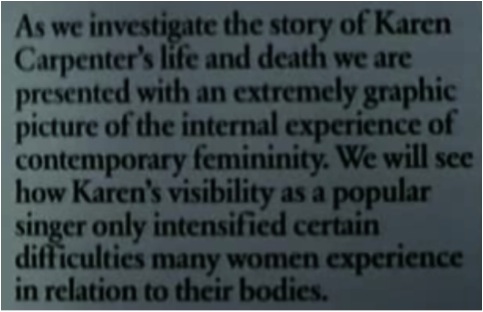
You might imagine that the whole concept was a joke but you’d be wrong. The serious intent  of the film is evident from screen captions like the following:

The movie presents a humane perspective on a debilitating and much misunderstood illness and deals with Karen Carpenter’s brief life with real compassion.

Related articles