
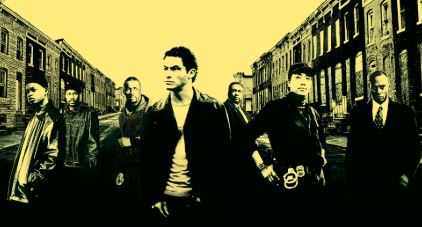
An endorsement by the cast of The Wire!
What more should anyone need to tell you that you MUST vote for Obama.
Please America – do the right thing this time!!!
An endorsement by the cast of The Wire!
What more should anyone need to tell you that you MUST vote for Obama.
Please America – do the right thing this time!!!

The main problem with writing about the HBO TV series ‘The Wire’ is that you quickly run out of superlatives.
I wrote about this show on September 16th 2007 after watching Season 3 and now having reached the end of Season 4, I have no reason to change my (and many others’) view that this one of the finest and most important TV series ever produced.
The Wire takes its title from the phone taps used by the serious crimes squad. In this season this investigative method is a non starter as the targets have got wise to this means of surveillance. The title still seems appropriate, however, given that the show is all about making connections between economic, sociological and political issues.
In the fourth (and penultimate) season the focus turns to the new generation of ‘corner kids’ in the underprivileged part of Baltimore. The problems of inner city education is linked both implicitly and explicitly with the power battles in the mayoral election campaign, the hierarchy in police departments and working methods of criminal gangs. The genius is in keeping all these plates spinning while maintaining the show’s integrity and believability.
They get this right because, while it is a work of fiction, it is based on a real and thorough knowledge of this city, which in many ways serves as a microcosm for other inner cities in America. The accuracy comes form the fact that the series creator, David Simon, used to cover crime stories with the Baltimore Sun while main series consultant is Ed Burns an ex-detective with Baltimore police department.
In season 4 the performances of the child actors are so convincing that you imagine they’d be playing these roles in real life if The Wire hadn’t employed them. One of the most amazing, and chilling, is Snoop played by Felicia Pearson (see above)who clocks up a high body count over the season’s 13 episodes. Before landing this role she sold drugs and spent more than seven years in jail.
This gives an insight into the urgent crusading message behind the series. It is more than just escapist entertainment. David Simon says that if they hadn’t got it right it would have been just another cop show. Instead it raises all the complex and messy day to day moral dilemmas that have to be faced by politicians, parents, kids, teachers, junkies, police and we the people.
The show doesn’t pretend to know all the answers but they sure as hell know how to ask the right questions.

I have just seen the amazing new movie ‘Gomorra’ directed by Matteo Garrone which was rightly hailed at the latest Cannes Film Festival.
Imagine the Baltimore of HBO’s ‘The Wire’ transferred to the mean streets of Naples and you’ll get a flavour of its power. It oozes authenticity mixing remarkable performances by non-actors and actors who speak with such a strong Neapolitan and Casalese dialect that it has to be subtitled even for Italian audiences. Continue reading


I was drawn to this novel by the fact that George P. Pelicanos is one of the key writers on HBO’s brilliant ‘The Wire’.
The drama of this fine novel unfolds slowly; you have to wait until past the novel’s half way point to reach the “senseless death on a sunny afternoon” referred to in back cover blurb.
As in ‘The Wire’ , the tendency is away from Hollywood style sensationalism and towards an exploration of all the intricacies that lie behind real life dramas. After the killing itself our patience is rewarded with the following purple passage:
“Because of the numbing consistency of the murder rate, and because lower-class black life held little value in the media’s eyes, the violent deaths of young black men and women in the district of Columbia had not been deemed particularly newsworthy for the past fifteen years. ……………..Suburban liberals plastered Free Tibet stickers on the bumpers of their cars, seemingly unconcerned that just a few short miles from the White House, American children were enslaved in nightmare neighborhoods, living amid gunfire and drugs and attending dilapidated schools. The nation was outraged at high school shootings in white neighborhoods, but young black men and women were murdered without fanfare in the nation’s capital every single day”
This kind of explicit commentary is not particularly representative of the novel as a whole but sums up the underlying philosophy behind it. There’s a rage but also a compassion for the criminals as well as for the victims of crime. It’s a world where the ‘good guys’ (private investigators Derek Strange and Terry Quinn) struggle under the weight of the moral dilemmas they are faced with. Pelicanos makes no bones about the fact that the drug culture and criminal world offers a fatal attraction for those from impoverished backgrounds. He points no finger of blame at those who adopt this path. He suggests that only the qualities of strength of character and sheer bloody mindedness are likely to turn things around.
Pelicanos is never glib or simplistic – he gives an uncompromising depiction of a fucked up urban landscape with the barest semblance of order and structure. He gives an unflinching insight into the warts and all reality of the modern world but still manages to leave the reader with a glimmer of optimism.


Here’s a good mission impossible – Google HBO’s The Wire and try to find someone who isn’t mad about the show. It was the universal acclaim of Metacritic that first spiked my interest and I decided to take a chance on buying the Season 1 box set. One of my better decisions!
It’s a show where you just run out of superlatives. Now, I’ve just got to the end of Season 3 and have to wait until number 4 hits the shelves. It’s something of a cliché to read of a show getting better and better but in this case it’s the truth. The creators – notably writer David Simon and producer, ex-Baltimore homicide cop Ed Burns, deserve all the acclaim that’s heaped upon them. HBO also should be praised for sticking with the show even when the ratings didn’t match the critical reception.
What makes it work? I’d say it’s the fact that it doesn’t use cheap gimmicks or contrived plot twists to draw the viewer in. You’re hooked by the sheer quality of the writing and ensemble acting. As many have commented it works like great literature.
In Season 3 this reaches new heights of excellence with the almost unbearable tension between street gang leaders Avon Barksdale & Stringer Bell magnificently played by Wood Harris and Idris Elba respectively. My favourite character is still Omar (Michael Kenneth Williams) who is still alive and out of jail so will hopefully feature in seasons 4 and 5.
I can’t wait!


 | Sabine on WHAT MAKES HOSING FUN? |
 | MaleFriends on IN PRAISE OF THE HAIRY CHEST |
 | Anonymous on COPYCAT KILLER IN DUMB MOVIE |

