Tag Archive: Cannes film festival


The autoeroticism of Titane

TITANE directed by Julia Ducournau (France, 2021)

“An auto-crash can be more sexually stimulating than a pornographic picture” – William Burroughs (From the preface to The Atrocity Exhibition by J.G. Ballard)
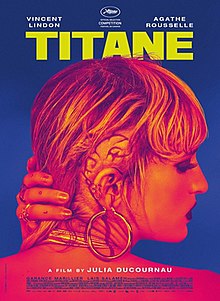
While conventional cinema barely scratches the surface of the psychopathology of sexual relationships. ‘Titane’ dares to go deeper and the results are a heady mix of disturbing realism and rampant absurdism. The violence is stylised yet gruesome; the tenderness is awkward yet credible.

The singular fate of Alexia (Agathe Rousselle) is to be more turned on by the gleaming metal of cars than the flesh of humans. As a steamy, sensual dancer she dry humps Cadillacs and when the showtime is over she climaxes in the back seat of one of these vehicles to bring a new meaning to the term auto-eroticism. Later, she literally bleeds motor engine oil.

She has a prominent tattoo on her chest denoting the title of Charles Bukowski’s book of poetry : “Love is a dog from hell.” This gives fair warning that she is not of a romantic disposition. Things end badly for those who enter her intimate space. You can look but don’t touch.  

Bukowski also wrote “there is a loneliness in this world so great that you can see it in the slow movement of the hands of a clock” and the pain of Alexia’s isolation is evident. Self-harm is for her a way of life.  To say that she is damaged goods would be an understatement. After a childhood car crash, she wears a titanium plate in her head as a badge of honor.

After a brutal killing spree, Alexia finds unlikely solace in the equally troubled Vincent (Vincent Lindon) who becomes a surrogate father figure. Both crave closeness yet their driven natures mean they are forever destined to be loners.

The fetishism towards automobiles is so obviously Ballardian that Ducournau’s vision has inevitably been linked with David Cronenberg’s  ‘ Crash’ , a movie which won the Special Jury Prize at the 1996 Cannes Film Festival “for originality, for daring, and for audacity”.

 In 2021,  Titane won the Palme d’Or at Cannes for the similarly provocative and deliberately polarizing treatment of sex and violence. Aside from obvious affinities with  ‘Crash’, it is probable that Cronenberg’s remake of  the body horror classic ‘The Fly’ was also an inspiration to Julia Ducournau.

Its plot holes are plain to see but this is filmmaking that is prepared to take risks rather than making do with conventional feel good confections that pass for entertainment. The flaws are evident but the uncompromisingly full-blooded performances of Rousselle and Lindon make this an unmissable treat for lovers of mindfuck movies and an instant cult classic.

The truth to power of Ken Loach

e

I, DANIEL BLAKE directed by Ken Loach (UK, 2016)

blakeIn part 12 of his illuminating Channel 4 documentary series on The Story Of Film, Mark Cousins focused on notable directors from around the world like John Sayles in the US and Krzysztof Kieslowski in Poland who were prepared to stand up for worthy, though unfashionable, political causes.

The connecting theme was what Cousins frequently referred to as ‘speaking truth to power’, a phrase that originated with the Quaker movement in the 1950s and was later adopted in the United States as a rallying call to those opposing the dark forces of Fascism and totalitarianism.

For half a century, Ken Loach has followed this principle by being a voice for the dispossessed and downtrodden in society. He opposes the political establishment that serves the masters yet ignores the slaves. He stands against systems which sustain the healthy and the wealthy but provide little nourishment to the poor and needy. Continue reading

Mark Cousins after a few late nights, (Photograph: Gareth Cattermole/Getty Images)

Mark Cousins may look he’s been dragged through a hedge backwards  in his publicity photos but he is a gentle soul with a lot of wisdom to impart.

I enjoyed an interview in the Guardian  about his new movie that has been  premiered at Cannes and can’t wait to see  A Story Of Children And Film.

This sounds like it follows in the same vein as the wonderful Story Of Film series he made for Channel 4, ie. lilting voiceover and a refreshingly global perspective on the magic of movies.

He explains how children can be more transparent and truthful than adults : “They are not ashamed of bawling or crying just because they want something – and switching it off and turning at once to laughter. They don’t feel they have to disguise the nakedness of those emotions. It’s not just that we mask and they don’t – they are faster in their feelings, I think.”

THE NOT SO FANTASTIC MR. FOX

FANTASTIC MR. FOX directed by Wes Anderson (USA, 2009)

Wes Anderson (illustration by Jame Taylor)

With Wes Anderson’s new movie Moonrise Kingdom getting a lot of publicity at this year’s Cannes Film Festival, I was alerted to the fact that I had missed his Foxy predecessor.

It’s quite a strange film because, while it  looks like a kids movie, it probably holds more appeal for an adult, arty audience. Continue reading

THIS MUST BE THE PLACE

Paolo Sorrentino’s Il Divo, a masterly film portrait of the ultimate political survivor Guilio Andreotti, so impressed Sean Penn at the 2008 Cannes Film Festival that he told the Italian director he would be happy to consider appearing in any future film he made.

Taking the bull by the horns Sorrentino went away and wrote the part of a former Goth-rock star with Penn in mind. To his delight and amazement, Penn accepted immediately.

Sean Penn plays Cheyenne, a 50-year-old adolescent with the slow, awkward gait of an intense teenager carrying the weight of the world on his shoulders.

Cheyenne is described by  Sorrentino as “childish, but not capricious. Like many adults who remain anchored in their childhood he has a knack of maintaining only the limpid, touching and bearable qualities of kids”.

For the role, Penn adopts a camp, emotionally detached voice yet despite his apparent boredom , bordering on depression,  he is always fully engaged with those he speaks with. There are some great one liners that would have fallen flat if he had played the part in a more extravagant manner.

Robert Smith – the other Cheyenne.

The general look of the character, with bright red lipstick and a ‘pulled through the hedge backwards’ hairstyle is, unsurprisingly, based on The Cure’s Robert Smith.

The movie’s title is taken from a track by The Talking Heads and we hear various versions of the song during the course of the movie. The best of these is a live rendition with David Byrne and band at a New York hotspot.

Byrne plays himself in as an old friend of Cheyenne’s. The contrast between the two is stark with the uber-cool DB looking like a fallen angel all in white (hair included) while the lost Cheyenne, dressed from head to toe in black, seems cursed to live out his days frozen in a vague memory of his past glories.

The death of his estranged father reluctantly takes Cheyenne from his retirement mansion in Dublin back to New York. He discovers his father, a holocaust survivor, had an obsession to seek revenge for a humiliation he had suffered in Auschwitz. Intrigued by this story, Cheyenne embarks on an unlikely mission to seek out his father’s persecutor, partly to relieve the tedium of his life and also to belatedly discover something of his estranged father’s past.

Sorrentino said that he took some inspiration from another offbeat road movie , David Lynch’s A Straight Story, and it seemed to me to that he also borrows ideas and themes from David Byrne’s True Stories in that it views quirkier aspects of American life in the same way that an enthusiastic tourist engages with a foreign country. The Holocaust related quest also make me think of the novel and movie Everything Is Illuminated.

The soundtrack is exceptional. It’s always the sign of a director on top of his game when the music works to enhance the visuals rather than serving as some vague, tuneful backdrop. Sorrentino could easily have taken the soft option of a late 70s Goth-Rock mix of Siouxsie & The Banshees, Bauhaus, The Cure, The Mission etc. which might have reflected Cheyenne’s tastes but wouldn’t have fitted in with the story at all. Instead he shows immaculate taste by including songs by Will Oldham (Bonnie ‘Prince’ Billy), Vic Chesnutt, Iggy Pop, Jonsì & Alex and Julia Kent.

Great though the movie is, it is by no means flawless.  As a portrait of modern America there’s freshness and humour while the serious parallel plot of the Nazi criminal is far less convincing.

Still, it is easy to overlook such weaknesses in a fresh and humane movie that is by turns touching, funny, sad and unpredictable.