Tag Archive: Robert Bly


The Will To Change – Men, Masculinity and Love by bell hooks (Simon & Schuster, 2004)

Every man and woman, together wit those of undecided gender, should read this book. Wary men fearful of yet another feminist tract telling them how shit they are can breathe a sigh of relief.

bell hooks, real name Gloria Jean Watkins, wanted her pen name to be written in lower case so that people focus on her books, not her identity. She said : “I think we are obsessed in the U.S. with the personal in ways that blind us to more important issues of life.”

I confess that I have been unforgivably ignorant of the importance of her writing until very recently. With a crushing irony, my belated discovery came just a couple of months before she sadly passed away at the age of 69. The only positive that might come from her death is that her works will be republished and freshly promoted. Hers is a radical voice for our times with refreshingly inclusive insights such as the recognition that “sexist exploitation [will] not change unless men [are] also deeply engaged in feminist resistance.”

This is a book aimed primarily at changing men but hooks is insistent that this transformation will not happen without a fundamental shift in female attitudes. She is most critical of those sisters who fail to appreciate that men are as much victims of patriarchal culture as they are. Of course, she is not blind to be fact that men benefit most from the system but urges women to make a vital distinction between masculinity and patriarchy.  Maleness needs to divorced from the dominator model and to avoid all doubt on the roots of the problem and the scale of the challenge, she proposes the all embracive term “imperialist white-supremacist capitalist patriarchy.”

In this study, bell hooks defines patriarchy as “a social disease assaulting the male body and spirit” whilst noting that men who are aware of this often find themselves isolated from other men. This certainly rings true for me personally. In the 1990s, I joined a men’s group which took Robert Bly’s ‘Iron John’ as a sacred text. In this environment, it was obvious that it was far from empowering for us ‘reconstructed males’ to declare ourselves as feminists. The overriding suspicion was that people like us were engaging in sexual politics to further our own ends rather than to truly embrace equality between the sexes.  The consequence was that the so called ‘new man’ found himself between a rock and a hard place. Crucially, it didn’t pass unnoticed that unreconstructed males got laid more often and achieved a greater social status more easily.   

Gloria Jean Watkins aka bell hooks (September 25, 1952 – December 15, 2021)

Writing from a black female perspective, bell hooks is right to observe that her feminist peers strive to win the rewards and privileges of men in positions of power rather than suffer the slings and arrows of misfortune at the other end of the social scale. In so doing, they are merely helping to perpetuate the patriarchal model rather than working to dismantle it. On top of this, hooks concedes that women are capable of being as emotionally abusive as their male counterparts. She writes that “[they] have not proven that they care enough about the hearts of men” reasoning that “it is better to be a dominator than dominated”.

The overriding message of this book is it is only through co-operation and mutual support between men and women that positive change will come about.  Taking an unfashionably non-sceptical stance, she asserts that love can transform domination and that feminist writing, whether fiction or theory,  should be centred on the premise that “It is possible to critique patriarchy without hating men.

12 Rules for Life: An Antidote to Chaos by Jordan B. Peterson (Penguin Random House, 2018)

"Chaos is the domain of ignorance itself. It’s unexplored territory" - Jordan B. Peterson.
"Chaos is order yet undeciphered" - José Saramago (The Double)

jordanThe book ambitiously seeks to find common ground between a series of dichotomies such as crime vs punishment, Christianity vs Atheism, sacrifice vs impulsiveness, constraint vs liberty, fidelity vs promiscuity and, most important of all, order vs chaos.

It is the work of Dr. Jordan B. Peterson, a clinical psychologist  and professor of psychology who has taught at Harvard and Toronto universities.

More by design than accident, Peterson has become a key social media influencer thanks to numerous TV appearances plus a series of university and public lectures posted on You Tube. The book summarizes his core beliefs and advocates rules which he maintains will help us become better citizens with the added advantage of helping to fulfill our ambitions.

He states that “making your life better means adopting a lot of responsibility, and that takes more effort and care than living stupidly in pain and remaining arrogant, deceitful and resentful.” Central to his argument is that the weak are lured by the promise of unfettered freedom which only leads to chaotic, self destructive habits. Continue reading

robertbly-smlIn yesterday’s Blog Tag post I wrote that one book that had a big impact on me was Iron John – A Book About Men by Robert Bly. I read this as soon as it was published in 1990 while I was part of a men’s group in London and it was of those books that came along at just the right time as it spoke to me with an unfiltered directness. This is the part of Chapter One (The Pillow and the Key) that got me hooked from the start: “In the seventies, I began to see all over the country a phenomenon that we might call the ‘soft male’. Sometimes, even today, when I look at an audience, perhaps half the young males are what I would call soft. They’re lovely, valuable people – I like them – they’re not interested in harming the earth or starting wars. There’s a gentle attitude toward life in their whole being and style of living. But many of these men are not happy. You quickly notice the lack of energy in them. They are life-preserving but not exactly life-giving. Ironically, you often see these men with strong women who positively radiate energy”.
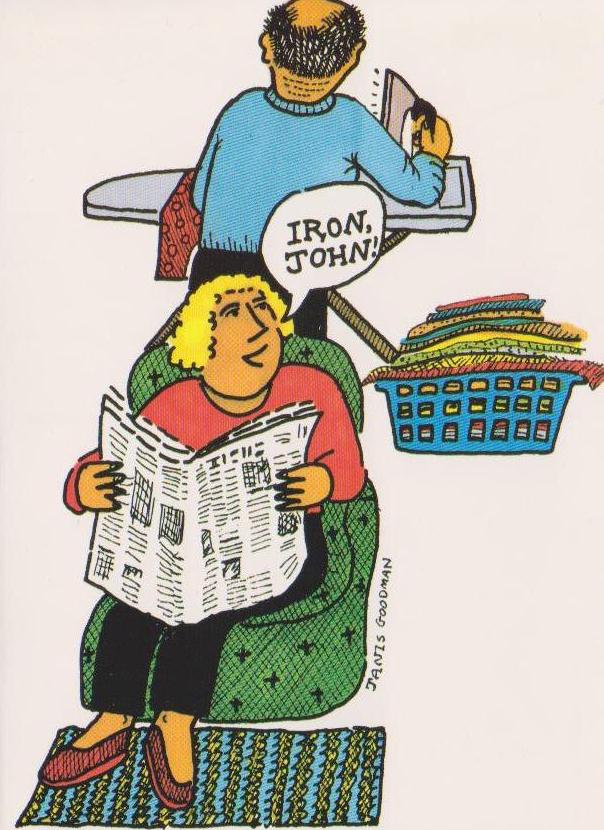
Iron, John by Janis Goodman (Leeds Postcards)

I identified with this because I knew I was one of these unhappy ‘soft’ men. I was so worried about being associated with the negative values of masculinity that I couldn’t  actually find many reasons to feel good about being  male. I made friends with women more easily than with men and was praised for my non sexist (read – non threatening) character. Yet, as Bly understood, to deny one’s maleness is ultimately to deny oneself. His book was widely attacked and ridiculed for celebrating the domineering mode of male behaviour that has led to the repression of women but this kind of knee-jerk reaction shows a fundamental misreading of Bly’s thesis. He was merely pointing out that simply asking men to be more in touch with their feminine side is not necessarily a healthy way forward.  The book  presents an affirmative definition of masculinity without this involving the devaluation or humiliation of women. Concepts like the ‘inner warrior’ and getting in touch with the ‘wild man’ are, Bly argues, essential in gaining a definition of manhood which is about strength and purpose rather than aggression and hostility.

HAMSUN’S ‘HUNGER’

During the National Novel Writing Month (nanowrimo) of November 2008, one of the forum threads asked writers to sum up their novel in one sentence. One wag said his was the story of “a man who walks around for a bit feeling sad”. It occurred to me that this is also a pretty fair description of a large amount of outsider fiction and it certainly would sum up fairly well Knut Hamsun’s 1890 novel ‘Hunger’.

In this story,the unnamed main character is lonely and constantly broke. A typical example of his daily routine is as follows:  “I got up, lay down again, put on my shoes, tramped around awhile in the dark, and lay down again, fought and battled against rage and terror till far into the morning hours, when I finally fell asleep”.. He’s a struggling writer who lives either in cheap rented flats or an abandoned tinsmith’s workshop.

His uncompromising determination to earn his keep from his creativity means that he lives a hand to mouth existence. This becomes literally true when at one point his starvation becomes so desperate he takes a bite out of his own finger! He draws blood,  licks it, looks at what he’s bitten and says to himself: “My God, I was a long way down.”

In allowing himself to “sink to less and less honourable deeds every day” he is a tortured soul who, much like Kafka, punishes himself for perceived weaknesses. It is a form of self loathing rather than self pity. He blames no-one but himself.  At one point he says he feels like an insect and notes “I had succeeded in making me disgusting to myself”. Given the bleakness of his plight, it’s odd that translator Robert Bly should describe it as “joyful book” , citing what he sees as the lively prose and intelligent playfulness of the Norwegian.

Maybe this is how he came to make some dodgy word choices in his version including describing the desolate anti-hero’s life as “a mess of pottage” and his refusal to engage in “hanky-panky foolishness on a sofa”.

The repetitive struggle becomes very tortured (“crying with grief over still being alive”) so, although it’s less than 200 pages long, I found it hard to read rapidly. It’s also hard to agree with Isaac Bashevis Singer’s opinion that “the whole modern school of fiction in the 20th century stems from Knut Hansun”. I admire the perseverance of Hamsun’s hungry ‘soul in torment’ without really being moved to feel pity for his self inflicted pain.
