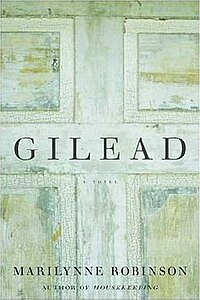
A while back I set myself a (still unfinished) goal of reading all the novels that have won the Pulitzer Prize. I did so because I felt I was only reading writers who I was already familiar with, or post-modernist works of contemporary angst .
This is how I, an Atheist, came to read a book by a Christian who professes to hate what she calls ‘clever writing’. All things considered, I should have hated Marilynne Robinson’s ‘Gilead’ and I do confess that when I first tried to read it I abandoned it as too slow and uneventful. I think I returned to it mainly because my efforts at novel writing for NaNoWriMo revealed how difficult it is to keep interest alive with an absence of high drama or contrived twists in the plot.
Robinson’s religious sympathies are evident from the novel’s title. Gilead is the name she gives to a fictitious town in Iowa but the biblical reference is surely no coincidence. In the Book of Jeremiah 8:22, balm in Gilead refers to comfort in distress, succour.
The fictional Gilead is depicted as a one horse town and one which , with its main ‘sights’ being a grain elevator and a water tower, would be unlikely to feature on a tourist trail.
The story is set in 1956 and takes the form of an extended letter from an ageing preacher man , John Ames, to his 7 year old son.

Marilynne Robinson
Ames’ first wife died in childbirth when he was 21 (a daughter also died after living for a few hours) and his second wife is 31 years his junior. Ames’ words are full of regret because he knows that now, at the age of 76 and in failing health, he will not see this child reach adulthood -“How I wish you could have known me in my strength”. In other words, he is a man who could definitely use some healing balm.
Ames has been such an upstanding and righteous citizen that he wryly reflects that when he dies “rejoicing in heaven will be comparatively restrained”.
Although he is aware that his life has been “sheltered and parochial” he still feels the need to pass on the, mainly bookish, wisdom he has learned (“writing has always felt like praying“).
We learn that Ames was born 1880 in Kansas: His father and grandfather have the same name and , to add to the confusion, the son of his friend and mentor was also christened John Ames (Broughton). The latter proves to be a thorn in the side of Ames senior. He is like an alter ego figure, the man he might have been if he had kicked over the traces more.
Broughton, a non believer , is a smart, rebellious figure who asks Ames tricky questions about the nature of faith. He is also regarded as a potential rival to the affections of Ames’ young wife and child. Broughton is thus the personification of a destructive spirit which threatens the tranquillity of Ames and by extension of the traditionalism of small town ways. The fruit of Broughton’s devilish nature are two children born out of wedlock, the first (who died young) from a fling with a poor servant and the second from a relationship with a black woman.
Ames’ tolerance is sorely tested. He is open minded up to a point (“it is better not to attempt too strict an isolation of children”) but he argues that “there is meanness in Atheism” and regards religious scepticism as futile and destructive. Nevertheless, his counter arguments in favour of Christianity are fairly unconvincing, He maintains that “nothing true can be said about God from the position of defence” which is a pretty effective way of stifling a debate before it even gets started.
Robinson herself seems to take much the same line in her otherwise articulate criticism of Richard Dawkins’ ‘The God Delusion’. She argues persuasively that “Dawkins’s critique of religion cannot properly be called scientific” but doesn’t feel the need to present her own perspective in any detail. She is content to write merely that “The reader may assume a somewhat greater admiration on my part for religion in the highest sense of the word, though I will not go into that here“.
Ames is a cop out in much the same vein. He encourages his son to read widely to develop his intelligence, but when it comes to the question of belief he is content to let the mystery be and so lamely advises “don’t look for proofs“. The wishful thinking of Ames, and presumably also of Robinson herself, is apparent as he imagines the afterlife as a place of “perpetual vigorous adulthood”.
At one point Ames muses wistfully that “material things are so vulnerable to the humiliations of decay” and the same humiliations beset his own decaying mind and body.
Robinson’s measured prose creates a vivid portrait of a man who, while sure of his faith, is still riddled with doubt about the worth of his life. Ames knows that when he dies the church where he preaches will be demolished . Robinson is probably in a minority in regretting the fact that Ames is one of a dying breed. I admire her for not taking the more predictable line of making him a figure of fun. Personally, I think her sympathy is wrong headed but I liked the compassionate tone of the novel just the same.


 During the National Novel Writing Month (nanowrimo) of November 2008, one of the forum threads asked writers to sum up their novel in one sentence. One wag said his was the story of “a man who walks around for a bit feeling sad”. It occurred to me that this is also a pretty fair description of a large amount of outsider fiction and it certainly would sum up fairly well Knut Hamsun’s 1890 novel ‘Hunger’.


 The support network, extra caffeine and online tips will hopefully see me through.