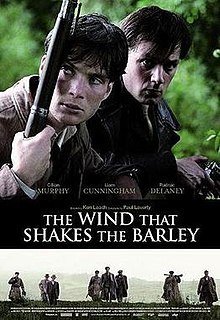
THE WIND THAT SHAKES THE BARLEY directed by Ken Loach (Ireland, 2006)
Ken Loach says “if we tell the truth about the past, we will have the truth about the present” but when strong emotions are stirred and the social and political stakes are so high, defining ‘the truth’ is no simple task. Undeterred, simplification of the issues is what Loach and scriptwriter Paul Laverty attempt in this movie.
The film takes its title from a mournful 19th Century ballad and won the Palme D’Or at Cannes but met with vitriolic attacks in the British tabloids, many of the fiercest critics being those who hadn’t even seen the movie.
Set in County Cork in 1920, it begins with the birth of the IRA as a revolutionary movement and ends with the Anglo-Irish Treaty of 1921 and its immediate aftermath.
I’m not sure if Loach and Laverty were directly motivated by the feminist slogan ‘the personal is political’ but in portraying how ordinary people can turn into revolutionaries there’s no doubt that the aim here is to show politics in personal terms. Continue reading →
Boolavogue is a rebel song composed by Patrick Joseph McCall in 1898 to mark the centenary of the Irish Rebellion. Its title is taken from the name of the town in County Wexford from which Father John Murphy led his parishioners against the British army in the Battle of Vinegar Hill. It all ended in tears as the insurgents were defeated and Murphy, together with other rebel leaders, was hanged.
The title of Enniscorthy-born Colm Tóibin’s excellent 1992 novel ‘The Heather Blazing’ comes from a line in this song: “A rebel hand set the heather blazing / And brought the neighbours from far and near”.
Although this novel is not overtly political, I think Tóibin chose this title is to make the point that such momentous events should not be confined to history books but instead form an integral part of the identity of the nation and its citizens.
The story revolves around a high court judge named Eamon Redmond; a pillar of the establishment but also a dissatisfied man fully aware of how his own past has shaped his character.
The novel’s seventeen chapters alternate between the past and present taking us from his childhood years through young adulthood before reaching the scenes from his present day life.
We see him as a studious youth who “learned to wait, to be quiet, to sit still”. He is raised by his father since his mother died when he was a baby. When his father suffers a stroke he is largely left to find his own path.
The most revealing insight to his adult character comes when he is challenged by his wife for being cold and distant. He replies: “I have never asked anyone for anything. I think I feel that if I did I would be turned down……..I don’t believe that anyone has ever wanted me”.
He faces the dilemma of having to decide on cases which impact on the Irish Republic’s subtly changing political and social life. This is most apparent when he has to decide if it is right to ban a single mother from continuing her studies at a Catholic school. The irony of the fact that he should be the one giving a verdict on this religious issue is made plain:
“As he worked on the judgement, he realised more than ever that he had no strong moral views, that he had ceased to believe in anything. But he was careful in writing the judgement not to make this clear.”
Predictably, he decides in favour of the school and his two grown up children, who are part of the new more radicalised generation, are critical of the role he adopts as a cog in the state machinery.
Tóibin’s writing is deceptively simple and he manages to depict the torment and isolation of the main character while maintaining a detached poise in his prose style.
The novel’s closing scene of the judge bonding with his grandson (born out of wedlock) offers a hint of the man’s vulnerability which allows us to understand and sympathise with a character who nevertheless remains as much a stranger to himself as to the reader.

 THE WIND THAT SHAKES THE BARLEY directed by Ken Loach (Ireland, 2006)