If this movie had met with universal critical acclaim or had achieved commercial success it would almost certainly have denoted its failure in artistic terms. Fortunately, therefore, it polarized the press and bombed at the box office.
J.G. Ballard’s novel (published in 1975) was meant as a morbid, provocative slice of entertainment designed to leave readers absorbed but seriously spooked. It begins arrestingly: “Later, as he sat on his balcony eating the dog, Doctor Robert Laing reflected on the unusual events that had taken place within this huge apartment building during the previous three months”.
This big screen adaptation has a similarly jarring impact since, in Ben Wheatley, we have a director whose mindset is every bit as warped as the polite but misanthropic English writer. Continue reading →
Darren Aronofky’s directorial debut is a horror movie about maths; or , more precisely, a horror movie about a man obsessed with maths.
The protagonist is Max Cohen (Sean Gullette) who began his lifelong obsession with the power of numbers as a child after he disregarded his mother’s advice and stared too long into the sun.
In his fried mind, he is convinced that there’s a mathematical explanation in everything.
He directs most of his energy, helped by a room full of primitive computer devices, in attempts to decipher the pattern recognition in the stock exchange. Given that he rages against “petty materialists” his motives for this appear to more cerebral than financial.
He is pursued by a group of unscrupulous money grabbers from Wall Street and his numeric know-how lures another bunch of Hasidic Jews ( Kabbalah scholars) who want him to direct his mind towards the higher goal of solving the mysteries of the Torah.
Along the way there are some techno-mumbo jumbo from his math-mentor Sol about computers becoming conscious and humans turning into machines
The movie is shot in saturated black and white as though the movie reels have also been exposed to too much sunlight. This heightens the surreal, claustrophobic quality which makes it reminiscent of the other-worldly industrial landscape in David Lynch’s Eraserhead. Both movies centre on bizarre individuals hovering on the edge of sanity.
The excellent score by Clint Mansell adds to the brooding menace, this music is augmented by tracks in a similar vein by Autechre and Massive Attack.
The complex intelligence and restless energy of Aronofsky is singular enough to keep you watching even if you haven’t got a clue what was going on in his head when he made this.
THE FOUNTAIN directed by Darren Aronofky (USA, 2006)
The Fountain is a convoluted fable about the pros and cons of immortality with a three-strand non linear narrative covering five centuries and Space Odyssey style special effects.
In the present day sequences, neuroscientist Tommy (Hugh Jackman) wants to cure his wife Izzi (Rachel Weisz) of a malignant brain tumour.
Experiments on a monkey (named Donovan) reveal the rejuvenating potential of a rare tree bark. This convinces him that he is right to dream of a cure for death which, he maintains, is just another disease.
Izzi, on the other hand, accepts that she is dying and realises that won’t be able to finish her fantasy novel. She assigns Tommy the task of writing the final chapter.
A dramatization of her story covers the ‘past’ section of the film. She casts herself as the Queen and Tommy as Tomás, a conquistador in 16th Century Spain. There, his mission impossible style quest is to find the tree of life. If he succeeds he will be able to share immortal wedded bliss with her. This provides an excuse to indulge in some medieval fight sequences in which Tomás survives thanks to a dagger with magical powers.
The future time scenes find Tommy in deep space as a Tai-Chi practising bald-head who erroneously thinks the tree of life is the answer to his prayers.
Ultimately this is a movie about coming to terms with our own mortality with the underlying message that unless you accept that you are going to die one day you won’t be able to make the most of living.
The Fountain has the potential to be a great movie but gets bogged down by the weight of its themes (although it does boast a brilliantly atmospheric score by the ever reliable Clint Mansell).
Aronofsky is a director with a lot of ideas but has a frustrating tendency to throw lots of ambitious concepts into the mix hoping that some of them work. In this movie, he boldly attempts to render the duality of life versus death as a complex allegorical romp but winds up with too much on his plate.
Only the present time love story contains the emotional weight the story needs, the rest just seemed like an excuse to create some visually striking sequences that feed the eye but don’t fill the heart.
With the recent rave reviews for Duncan Jones’ new movie, Source Code, I was curious to see his debut feature.
Duncan Jones used to be Zowie Bowie but wisely changed his name. He clearly wanted to show that he could be famous in his own right rather than being forever known as David Bowie’s son .
At the same time, if he really wants to escape the link with his famous dad then making a movie like Moon isn’t necessarily the best strategy.
After all, DB’s big breakthrough single came with the release of Space Oddity in 1969 which coincided with the Apollo 11 launch but also owed much to Stanley Kubrick’s groundbreaking movie 2001 A Space Odyssey.
This great tune has always sounded like it was made on the cheap largely because of the cheesy stylophone effect.
Duncan’s movie shows that he has inherited dad’s thrifty tendencies as well as a fascination for Kubrick’s magnum opus.
The plot centres almost entirely on lone astronaut Sam Bell (Sam Rockwell) who is employed by Lunar Industries. His job is to harvest fuel to supply Earth’s dwindling resources and his only companion , GERTY , is a computer. We meet him near the end of his three year contract looking forward to returning home to his wife and daughter.
This is a spoiler-free post so I won’t spell out what happens next, suffice to say that GERTY has a guilty secret and Sam’s plans are about to go pear-shaped. The circuits aren’t dead but there’s something not quite right on board.
The budget is a bit larger than Peter Cook and Dudley Moore’s Superthunderstingray but some of the moon models are not what you would call sophisticated. There is no digital animation and most of the film is Sam talking to himself or the machines.
Jones has clearly worked hard to keep within a budget of just $5 million as opposed to the $35 million he was able to spend on Source Code.
GERTY’s emotional range
This doesn’t diminish the effectiveness of his intelligent movie. The clever plot is more important than flashy visuals. GERTY,for example, (voiced in the style of HAL by Kevin Spacey) is little more than a tin can with arms with a screen showing emoticoms – happy, sad or neutral .
One good investment was to employ Clint Mansell to write the score which helps set the claustrophobic mood and create a sense of menace.
This isn’t exactly an action-packed Sci-Fi thriller but, then again, there was also a fair amount of floating in space in Kubrick and Tarkovsky. Jones knows exactly what he’s doing and I look forward to seeing whether he has spent just as wisely on Source Code.
Here’s the trailer for Moon and the classic sketch for Superthunderstingray from Not Only…But Also in 1968.
The cause of addiction is that the drugs work all too well when you first take them.
The euphoria and mind expanding potential is not glossed over in in Darren Aronofsky‘s 2000 movie Requiem For A Dream but neither are the gruesome tales of misery and despair that follow.
The film is based on a novel by Hubert (Last Exit To Brooklyn) Selby Jr, a man who knows all about the whys and wherefores of getting hooked as he was dependent on painkillers and heroine for the early part of his life.
Selby kicked his habit before he was 40 but the notion that addiction is something that goes with youthful delusion and naivety is dispelled in this novel/movie.
The most heartbreaking character is that of Sara Goldfarb (played brilliantly by Ellen Burstyn) as the widowed mother of Harry. In her lonely existence, daytime television is her only comfort and when a cold caller says she has won a place a game show her life takes on a new purpose. Continue reading →

 If this movie had met with universal critical acclaim or had achieved commercial success it would almost certainly have denoted its failure in artistic terms. Fortunately, therefore, it polarized the press and bombed at the box office.
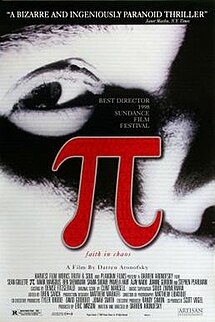 Darren Aronofky’s directorial debut is a horror movie about maths; or , more precisely, a horror movie about a man obsessed with maths.
 The Fountain is a convoluted fable about the pros and cons of immortality with a three-strand non linear narrative covering five centuries and Space Odyssey style special effects.
 The future time scenes find Tommy in deep space as a Tai-Chi practising bald-head who erroneously thinks the tree of life is the answer to his prayers.

 The cause of addiction is that the drugs work all too well when you first take them.


