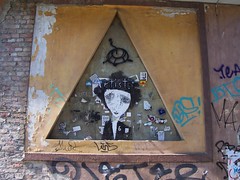
In week 3 of the E-Learning & Digital Cultures MOOC . students have been invited to create an image that represents any one of the themes encountered in the course so far.
This is another photo of street art from my Flickr back pages that I have chosen.
It was taken in San Francisco and it makes me think of time travellers returning to the Garden of Eden (wherever that is!). The fact that the couple has not been coloured in adds to the sense of their disconnection from the natural surroundings.
It makes me think how technology separates human beings from our surroundings so that we feel we are aliens trying to come to terms with where we are and how we are supposed to interact with the world around us.
In week 3 of the E-Learning & Digital Cultures MOOC . students have been invited to create an image that represents any one of the themes encountered in the course so far.
I’m not entirely sure if cropping my Flickr photos counts as being sufficiently creative but I’ve been going through my past shots of graffiti and street art looking picture that fit this category.
My favourite is this one I took in a side street in Ravenna, Italy which I think serves to counter balance the dystopian notion that machines are taking over our world.
if robots are invested with human characteristics, perhaps they can feel lonely too.
This yellow bot certainly looks isolated and in need of love.
Perhaps the true fear we should address is not that machines are becoming too powerful but that human beings are too distrustful of the idea that technology can be a force for good.
SLEEP FURIOUSLY directed by Gideon Koppel (Wales, 2008)
The title of this beautiful and poetic film is a reference to Noam Chomsky’s sentence “Colorless green ideas sleep furiously”.
This phrase was given as an example of a grammatically correct, but meaningless, linguistic construction. Chomsky’s intention was that people would recognise that the language we use cannot be glibly reduced to tidy formulas. Ironically, it has been proven that the phrase he chose to illustrate his point can actually make perfect sense given the right context.
Gideon Koppel’s film is set in Trefeurig, a farming community in Wales where he lived from the age of 12; a place of peace and refuge for his Jewish parents after fleeing Nazi Germany . Koppel’s mother features as one of the key characters in the village.
Koppel’s unique film goes beyond the scope of a straight documentary in that it neither lectures nor explains, but simply asks audiences to observe and draw their own conclusions from the images of ordinary lives and the natural landscape. By these means, his visual language has a function that is more than just for communicating information or affirming a specific point of view. Like Chomsky’s sentence, the context.is what gives it meaning<!
Perhaps the recognition of the limits of language also influenced his choice of music for the project. He uses several ambient electronica pieces from Aphex Twin’s Drukqs, an album where many of the track names are invented words or amalgamations of Cornish and Welsh.
It should be noted that Richard James (Aphex Twin) admired the film but wasn’t too enamored about the way his music was edited. The abrupt cuts to Avril 14th, a track that is used as a repeated refrain throughout, are made because Koppel didn’t want the music to be used as conventional soundtrack but needed it to denote “an accentuation of the emotional dynamics of drama”. He justifies the crude editing of the music by saying that “throughout the film we are asking the audience to listen to the silence” .
One of the most striking aspects of the film is how unobtrusive the camera and production team are. The inhabitants are not directly interviewed and there is no voiceover to explain how we are supposed to read the scenes. A great strength is that there is never any sense that the conversations are rehearsed or scripted. It is as if we are merely eavesdropping on the working and domestic lives of a range of local inhabitants, young and old, whose point of connection lies in the fact that they all live in the same place.
The camera often remains static and rarely follows the source of sounds. For instance, we hear, but don’t see, a jet plane flying over a field and, in a choir rehearsal, we hear the singers but the camera remains fixed on the woman conductor throughout.
The natural setting is vividly evoked, showing the subtle changes of the seasons and how the precision of the farming methods have a poetry of their own. It was shot on super-16mm film to enable Koppel to capture all the subtle changes in light and textures.
Following the progress of a mobile library gives a framework to the film, this van is literally a vehicle of stories but otherwise there is no narrative link to connect the other scenes in the school, the homes, the farms or on the land. Koppel has spoken about an influential meeting with the Austrian writer, Peter Handke. who encouraged him to set aside the idea that all movies must have a big dramatic arc.
If the film can be said to have a message or purpose it is to remind us how the notion of ‘community’ should be viewed as something that affects people’s daily lives rather than as a political concept. One issue that unites the community of Trefeurig is the threat to the future of the village’s primary school and we see a meeting where the locals criticise the council’s short-sighted decision to close the school.
Change is inevitable but does not always bring improvements, something neatly encapsulated in a witty poem about replacing a wooden signpost with a metal one. The new one is sturdier yet proves unreliable whenever there’s a strong wind. Wood may rot but a least the indicators remain in the correct position.
The spectre of modernity is always present and means that you can’t watch this film without the sad reflection that the inevitable march of progress will sweep away the old traditions and values depicted.
Sleep Furiously preserves for posterity moments and memories that will fade in time. The lines that appear on-screen near the end of the film remind us of the limitations of language when it comes to articulating what this means in human terms : “It is only when I sense the end of things that I find the courage to speak. The courage, but not the words.”
I would recommend buying the DVD as this includes a one hour pilot film called ‘A Sketchbok for The Library Van’ where, in a series of straight to camera monologues, the people talk about their lives. As in the main feature, the ordinary becomes extraordinary.
Hitting a financial crisis, a family from Pondicherry in India decide to cut their losses and move to Canada taking their zoo with them so that they can sell the animals to help support themselves. During the ship journey they encounter a violent storm and all die expect for a zebra, a hyena, an orangutan, Pi and a Bengal tiger. Eventually this lifeboat load is reduced to just Pi and the tiger.
It’s an eccentric story that a couple of decades ago could only have been brought to the big screen in a cartoon format. Now, technology has developed to the point that director Ang Lee has been able to call upon the expertise of Rhythm and Hues Studios in California to conjure up remarkably lifelike images of wild animals, flying fish and the changing moods of the ocean.
This studio has previously worked on films like Cat & Dogs and Narnia but nothing from their previous works reaches such artistic heights. Ang Lee adds the poetry and panache to the template. With a CV that includes Hulk and Crouching Tiger, Hidden Dragon, he’s no stranger to studio trickery although the challenges here are on an unprecedented scale.
The effects are quite extraordinary and bring the tiger named Richard Parker to life. The shipwreck scene is also a breathtaking piece of pure cinema. Continue reading →

 In week 3 of the E-Learning & Digital Cultures MOOC . students have been invited to create an image that represents any one of the themes encountered in the course so far.
 In week 3 of the


 Hitting a financial crisis, a family from Pondicherry in India decide to cut their losses and move to Canada taking their zoo with them so that they can sell the animals to help support themselves. During the ship journey they encounter a violent storm and all die expect for a zebra, a hyena, an orangutan, Pi and a Bengal tiger. Eventually this lifeboat load is reduced to just Pi and the tiger.