Tag Archive: madness


FOUCAULT ON REASON AND MADNESS

MADNESS & CIVILIZATION by Michel Foucault

(Translated from the French by Richard Howard) First published 1964

Subtitled ‘A history of insanity in the age of reason’, this densely argued and fascinating book shows how madness as a spectacle and disability has fascinated and haunted the history of mankind since the 15th century.

In this meticulously researched, controversial study Foucault observes how “fear of madness grew at the same time as fear of unreason”. This was represented in Goya’s famous etching ‘The Sleep of reason produces monsters‘. Hieronymus Bosch was another artist who depicted madness to symbolise the fall of man.

This book begins at the end of the Middle Ages after a cure for leprosy had been found. Foucault shows how the role of the leper in society was replaced by the poor, the criminals and the insane.

Madness represents the direct opposite of strength, purpose and reason so is associated with weakness, dreams and illusions. Continue reading
THE MASTER, MADNESS AND MARMITE

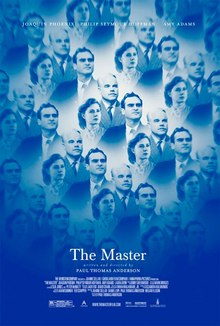
THE MASTER directed by Paul Thomas Anderson (USA, 2012)

I was prematurely dismissive about There Will Be Blood, Paul Thomas Anderson’s previous movie. I only really appreciated its quality and power on second viewing. I strongly suspect that the same will be true of The Master and certainly feel inclined to reserve final judgement until I’ve had chance to see it again.

The film’s opacity and lack of plot mean that there is a temptation to dismiss the universal critical acclaim it has garnered as hype and it is clear that,beyond the smart press, it has already divided ‘ordinary’ punters. It has been branded as a Marmite movie, something you’ll either love or hate.

If asked the question ‘what is it about?’, the most typical reply would be that it is a veiled study/satire of the birth of scientology but this seems a bit reductive to me. As it raises philosophical issues about the nature of madness, rationalism and existentialism, dismissing it on the grounds that there’s no narrative arc seems to me to be a superficial reading. Continue reading

GHOST WRITERS OF NYC

THE NEW YORK TRILOGY by Paul Auster

Do writers have real lives?

This is the implicit question that lies at the heart of these three separate though interconnected stories. They all share the same setting (New York, obviously), the genre (Detective fiction with an existential twist) and each deal with themes of identity, isolation and intrigue.

In The Locked Room, the final part of the trilogy, the author’s voice steps in to highlight the similarities: “These three stories are finally the same story, but each one represents a different stage in my awareness of what it is about”.

In the first story, City Of Glass, Quinn is employed as a private eye and describes his assignment to watch Stillman as a “glorified tail-job” which entails long hours  watching and waiting for something to happen. Nothing does. Continue reading

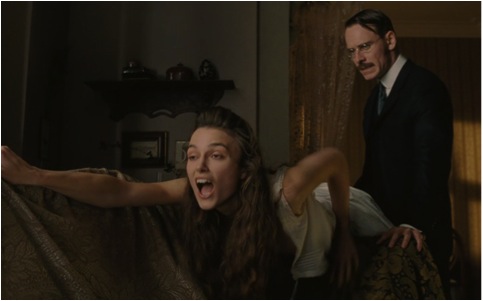
A DANGEROUS METHOD directed by David Cronenberg (Canada, 2011)

"Trust me, I'm a doctor!"

‘Restrained’ and ‘tasteful’ are not adjectives I want to see associated with David Cronenberg.

It’s as incongruous as describing a Terry Gilliam as understated and temperate or David Lynch as cosy and reassuring.

For a film that deals with sexual behaviour and personal liberty you’d expect A Dangerous Method to stir up some healthy controversy. Yet, the normally provocative director seems intent on maintaining an uncharacteristic (and unwelcome) level of respectability.This means that Viggo Mortensen, who plays Sigmund Freud, is not being ironic when he calls it Cronenberg’s Merchant-Ivory film. Continue reading

LADY GAGA – THE MORPHINE PRINCESS

You don’t have to be mad to be a superstar, but it helps.

Lady Gaga bares all , well almost, in her video to the single Marry The Night.

In the 14 minute video (which she directed herself)  you have to wait until  the 8:48 mark until the music itself  kicks in. The song will be a massive hit but that goes without saying. What’s more interesting is the way Lady G presents her vulnerability and psychological trauma as a vehicle for fame. It’s as if this is being presented as necessary to stardom rather than an unwanted by-product.

In the pretentious voiceover she refers to her past as “an unfinished painting” and declares “I loathe reality”. The first scenes show her in an asylum and telling a nurse (who calls her a “morphine princess”) that :   “I’m gonna make it …..I’m gonna be a star……because I have nothing left to lose”.

One Flew Over The Cuckoo’s Nest morphs into Fame via Black Swan and Cronenberg’s Crash. After freaking out and overdosing on Cheerios she pulls herself together and reinvents herself (“I still had my Bedazzler”) – the dance sequence starts – cars are set alight and it’s business as usual except that  P-P-P -Poker becomes M-M-M-Marry.

“I’m a warrior queen ……..I’m a soldier to my own emptiness” she sings and I wouldn’t argue with either statement.

Related link:
Marry The Night is either sublimely brilliant or ridiculous (Nerve.Com)