HUGO directed by Martin Scorsese (USA, 2011)
 It’s a sign of the times that two films in contention for this year’s Oscars are essentially reminders of the magic of cinema and its power to help us visualise our dreams.
The Artist is a film by a French director in awe of the glamour of Hollywood while Hugo is a film by an American director set in Paris with a predominantly European perspective.
This is Scorsese’s first exploration of 3D and while this enhances its visual impact, the film is essentially an old-fashioned story of finding your place in the world and staying true to your beliefs.
In many ways, it is a celebration of escapism with the moral of the tale being that our fantasies only come true if we work hard to preserve them.
The missing part to a broken robot (automaton) is a heart-shaped key – symbolising that technical precision is nothing without an emotional component.
Scorsese’s Anglophile tendencies are evident from the fact that he has chosen a strong cast of mostly British actors including Asa Butterfield as Hugo, Jude Law as his father, Ben Kingsley as George Méliès and Christopher Lee as the bookshop owner. Chloë Grace Moretz as Méliès’s god-daughter Isabelle and Michael Stuhbarg as the film historian are the only American actors in leading roles.
Sacha Baron Cohen’s comic turn as Inspector Gustav is like a cross between John Cleese’s Monty Python satires of pompous officials and Peter Sellers’ bumbling Inspector Jacques Clouseau with a similarly vague grasp of the English language (“are they smelly flowers”).
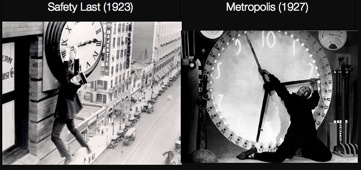 Intertextuality is always a feature of Scorsese movies and the nods to other movies are numerous in Hugo. The scene of the boy dicing with death by clinging to the hands of the railway station clock is obviously inspired by Harold Lloyd’s Safety Last (1923) which Hugo and Isabelle have seen together after sneaking into a cinema.
The scene perhaps also references the winding of the giant clock in Metropolis; the automaton also reminds you of the android Maschinenmench from Fritz lang’s 1927 movie.
There are also cinematic references to Hitchcock with Rear Window style voyeurism chases up staircases which made me think of Psycho and the bell tower sequences in Vertigo. I’m sure movie buffs will find more connections.
 Central to the story is also the appreciation of Méliès visionary films in the early 1900s, particularly Le Voyage Dans La Lune (1902). Scorsese’s reverence for the Frenchman’s innovative work is obvious and the biographical details of him are quite accurate.
Alongside the cinematic allusions, there are also literary analogies, mainly to Charles Dickens. Isabelle refers to David Copperfield as one of her favourite books, Ray Winstone is very Dickensian as Hugo’s alcoholic Uncle and the orphans live in constant fear of being taken off to the workhouse.
 Isabelle’s love of reading mirrors Hugo’s fascination for cinema. She likes to show off her wide vocabulary and so delights in using words she has learnt like “steadfast”, “covert” and “panache”. She has been brought up to find dreams in books while Hugo’s father introduced him to the wonder of movies at an early age.
Scorsese’s movie is based on American author Brian Selznick‘s 2007 illustrated children’s novel The Invention of Hugo Cabret but to think of it just as a kid’s film is misleading and I can’t see it being a major box office hit in these terms.
The Artist and Hugo hark back to the silent era of moviemaking. They remind us that the early cinematic greats were no less inventive and imaginative even though they had none of the modern technical and technological trickery. Both movies evoke a simpler age when the burdens of war, recession, man-made and natural disasters could be borne more easily because of an innate belief that hope and goodness would prevail.
“Come and dream with me” invites George Méliès and he ultimately realises that happy endings don’t just happen in the movies.
I’m not sure I entirely share this optimistic message but it never hurts to dream.

 Mister Pip is a modern-day fable in which a gentle human drama is sabotaged by the horror and brutality of war. Despite a shocking, and unnecessarily gruesome, finale, it is ultimately a compassionate story of hope.