SEXY BEAST directed by Jonathan Glazer (UK, 2000)

While waiting impatiently to see Under The Skin, I decided to take a look at director Jonathan Glazer’s earlier films.
I was familiar with his inventive work in advertising, notably the Guinness ads as well as his innovative videos with Radiohead and others but hadn’t seen either of his previous movies, Sexy Beast or Birth .
The boldness of Glazer’s debut on the former demonstrates the enormity of his talent. Not only does he assemble some fine actors but he also has the courage to cast against type.
Before seeing this movie, I wouldn’t have put Ben Kingsley down as an obvious choice to play an evil villain. On paper, Ray Winstone would be more convincing as a violent sociopath. You only have to see Winstone’s charged performances in Scum or Nil By Mouth to know that such a role would have come easily to him.
Instead Winstone plays Gary ‘Gal’ Dove, a washed out hard man who has decided to take early retirement from his ‘career’ as a safe-breaker. Gal has moved to a Spanish villa to escape the “grey, grimy shithole” of England.
In the opening scene he suns himself beside a swimming pool to the sound of The Stranglers ‘Peaches’. A sign that this Mediterranean idyll is about to be cut short occurs when a huge boulder rolls down the hillside and narrowly misses flattening him. The rock splashes into the pool. Don Logan (Ben Kingsley) as the human boulder is equally disruptive.
He arrives uninvited to ‘persuade’ Winstone to revive his criminal activities. The fact that Winstone, his wife and another couple are in a state of panic even before Logan appears builds the tension but only half prepares us for the foul-mouthed portrayal of pure evil.

You f****** c*** ! : Logan makes his point.
Kingsley totally sheds his non-violent Gandhian image to create a character whose bearing so epitomizes menace and cruelty that verbal taunts are as effective as physical violence.
With 300 uses of the word ‘cunt’ and 400 fucks, this is not a man with much time for small talk! He even manages to make a simple question like “How far’s the sea?” sound like a threat.
Another piece of inspired casting is Ian McShane as Teddy Brass, a ruthless heist organizer. As with Kingsley you see the shadow side of an actor. Prior to this, McShane was best known as diamond geezer, antiques dealer Lovejoy in the BBC drama series.
On one level Glazer’s remarkable directorial debut is a conventional macho gangster film like The Long Good Friday but under his stylized direction the story actually has stronger echoes of Performance. This comparison is heightened by cameo role by James Fox, who played the villain on the run in Nicolas Roeg’s masterpiece.
Sexy Beast rightly earned a lot of acclaim but had a limited cinema release, a fate that befalls far too many independent movies. Brave and uncompromising movie-making this good deserves a wider audience.
 It’s a sign of the times that two films in contention for this year’s Oscars are essentially reminders of the magic of cinema and its power to help us visualise our dreams.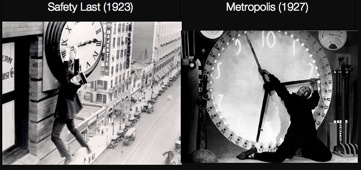
 Central to the story is also the appreciation of Méliès visionary films in the early 1900s, particularly Le Voyage Dans La Lune (1902). Scorsese’s reverence for the Frenchman’s innovative work is obvious and the biographical details of him are quite accurate.
 Isabelle’s love of reading mirrors Hugo’s fascination for cinema. She likes to show off her wide vocabulary and so delights in using words she has learnt like “steadfast”, “covert” and “panache”. She has been brought up to find dreams in books while Hugo’s father introduced him to the wonder of movies at an early age.