SILENCE. LECTURES AND WRITINGS BY JOHN CAGE (Marion Boyars Publishers Ltd, 2009)
 I have just marked this book as ‘read’ on Good Reads but I confess that I have not read every word, sentence or line .
I doubt whether there are many that have.
This is a source book.
A book to dip into.
If you attempt to read it form beginning to end your brain will hurt.
This is not a story and there is nothing linear about the text.
John Cage was not a conventional musician and not a conventional thinker. He knew the limitations and possibilities of sound and the difficulty of explaining what music was and/or what it was for.

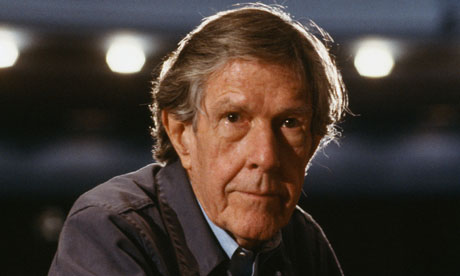
John Cage
He wrote that “the way to get ideas is to do something boring”.
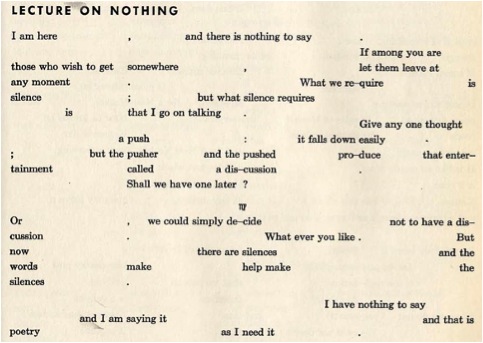
He didn’t pretend that his lectures were interesting. His lecture on nothing comes with the warning: “The text itself is repetitive and at times excruciatingly boring”.
Creativity is what happens between doing or thinking about something and nothing. It’s a Zen thing.
In Darling Boy (Beautiful Boy) John Lennon sang “Life is what happens to you while you’re busy making other plans”.
He begins his Lecture on something: by saying : “This is a talk about something and naturally also a talk about nothing. About how something and nothing are not opposed to each other but need each other to keep on going”.

Opening text to Lecture On Nothing.
He begins his Lecture on Nothing: by saying; “I have nothing to say and I am saying it and that is poetry”
He liked asking questions but one of these was ‘Is it true there are no questions that are really important?”
The final talk in this collection is entitled ‘Where Are We Going? And What Are We Doing?‘ but don’t expect to find the answers in the text.
Many may regard this as pretentious and deliberately obtuse – two of many criticisms levelled at Cage. It was suggested that Cage would shock people more if he gave a conventional talk, to which he replied : “I don’t give these lectures to surprise people but out of a need for poetry”.
He composed his talks like he was giving a musical performance so the timing of the delivery was often as important as the words. They were meant to heard and not read so the book attempts to replicate the character and shape of each lecture. For example, a lecture on ‘Indeterminacy’ is written in extremely small type “in an attempt to emphasize the intentionally pontifical character of this lecture”.
It is not an easy read but it contains a wealth of ideas and it’s a book I continually pick up much as believers might pick up a bible looking for revelations or insights from a random choice of text.
The debt modern musicians owe to Cage is enormous even if they have never heard his music OR listened to / read his lectures. His experiments with sound were dismissed as the actions of a lunatic but today samples, tape loops, field recordings, random noise , programmed beats and the use of ‘non musical’ instruments are commonplace.
As I said, the talks were meant to heard and Ubuweb has many valuable sound archives that illustrate the point. For instance it is interesting to compare two recordings of Lecture on Nothing.
One is performed by Frances-Marie Uitti From the album “Works for Cello; Lecture on Nothing”, (EtCetera Records, 1991)
The other is by Kaegan Sparks with ambient noises of Christian Marclay

 UbuWeb today turned me onto The Nothingists.