
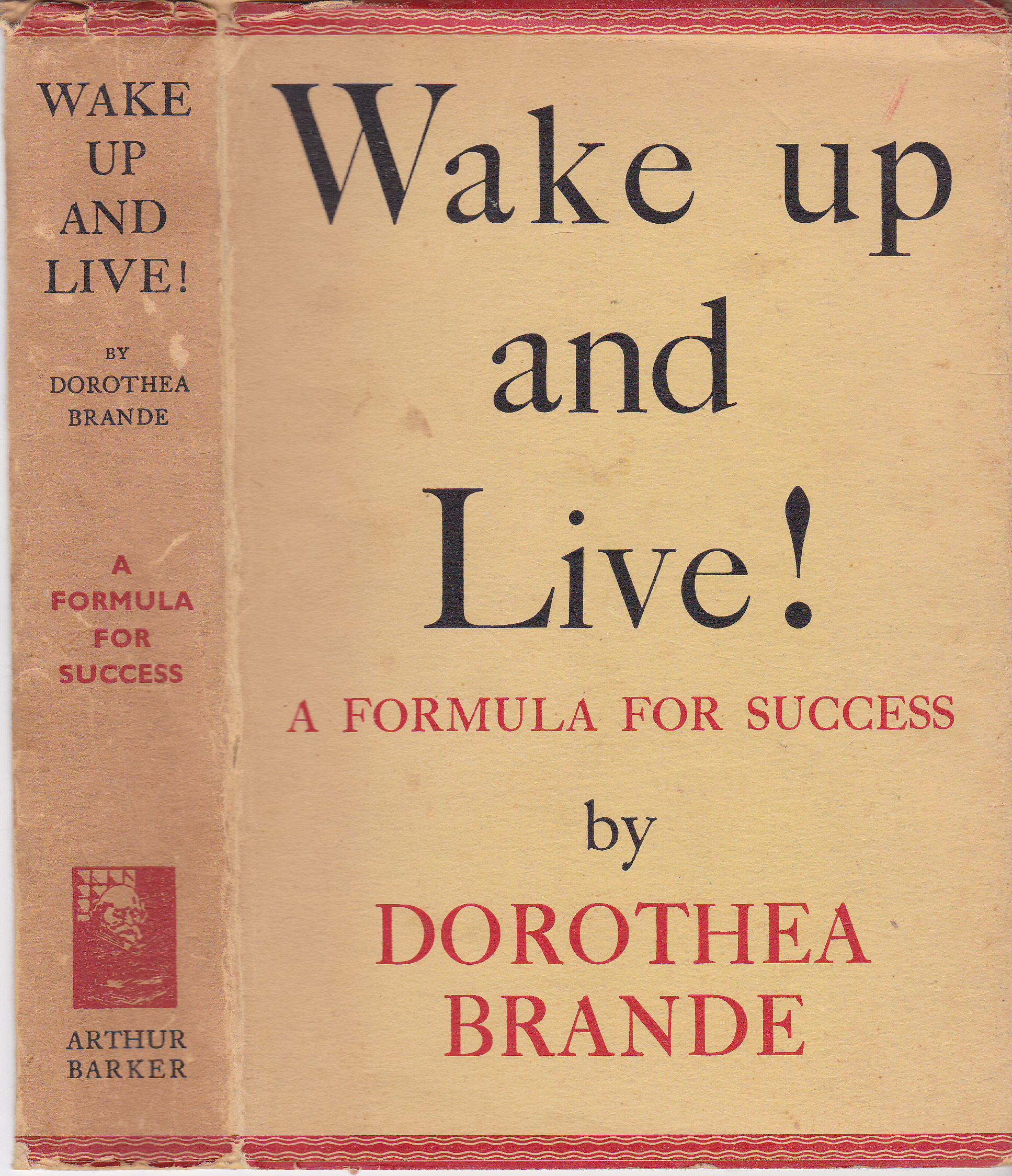
 Following on from yesterday’s post on searching for a lost voice, and still feeling a need for greater clarity in my thinking, I reached for a book from my bookshelf that always gives me sustenance and hope.
Wake Up And Live! by Dorothea Brande is a book first published in 1936 which I bought 35 years ago for 70p from the Stafforshire Book Company in Lichfield (which is sadly no more). While a little dated , this book will probably never reach a sell by date since the sound advice contained in the pages is so down to earth and practical.
Unlike so many works in the field of self-help, it does not carry any hidden religious agenda – it doesn’t require the reader to have faith in a higher being; the only faith you need is a belief in yourself.
“Act as if it were impossible to fail” is the one recurring axiom- a philosophy that demands a degree of self belief (some might say self-delusion) which is crucially underpinned by discipline and perseverance. At the heart of her formula for success are twelve disciplines that she followed herself – this are listed on the back flap of the book and are as follows:
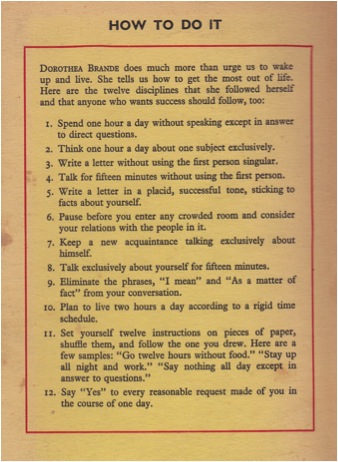
Her advice is given on the basis that she followed these disciplines and they worked for her. In her introduction she details how they “revolutionised her life.” Instead of procrastinating and labouring over her writing with little to show for her efforts she lists what she wrote in the two years following her discovery: “three books (the first two in just two weeks less than the first year, and both successful in their different fields), twenty-four articles, four short stories, seventy-two lectures, the scaffolding of three more books; and innumerable letters of consultation and professional advice sent to all parts of the country”.
Of course in the grand scheme of things, the Chicago-born author achieved a relatively modest degree of success – she died in 1948 aged 55 and only one of her books (Becoming A Writer) is at the time of writing currently still in print. But Wake Up And Live! was a big hit in its day. It sold over two million copies in 1937 and a story based on its underlying philosophy became a much-loved Twentieth Century Fox musical starring Alice Faye and Jack (‘Tin Man’) Haley.
A major strength of the book is that Brande is not prescriptive about how she defines success. It does not contain instructions on how to get rich quick or set out ways to become famous overnight. The implicit message is that we all know deep down in our hearts when we are truly fulfilling our potential and the formula she proposes encourages everyone to take steps to putting ideas and beliefs into practice.
Above all, this means rejecting the comforting, yet ultimately deadening, routines we can so easily slip into and embracing a more dynamic way of living that combines rigorous self-discipline while allowing oneself to be constantly open to new ideas and experiences.
Most personal growth books advocate auto-suggestion and positive thinking as a route to genuine change and Wake Up And Live! is no exception. It stands apart from the competition, however, because it is written in plain English and you get the strong impression that Brande felt compelled to write this book for genuinely altruistic reasons.
The final chapter is entitled ‘….And the best of luck!’ and concludes with the words: “Success, for any sane adult, is exactly equivalent to doing his best. What that best may be, what its furthest reaches may include, we can discover only by freeing ourselves completely from the Will to Fail”.
You better believe it!



I recently read Becoming A Writer. It was stimulating. And as you nicely put it, she writes ‘out of a genuinely altruistic motive’. I had the image of a strict school teacher in my mind while reading the book. The pdf link is actually typed in! Hats off to whoever took the effort.
Dinanath
This website is a great read.
I’m transcribing the 1937 diary of a 19 year old woman. I had to check “Dorothea Brande” to make sure I was reading the handwriting correctly. And that’s how I found your site.
This young woman* mentions reading the book. But beforehand she explains her context — the Depression. She wrote: (March 7, 1937)
“When we first entered High School we were told that no one could find a job in that year and it might be better 4 years later when we got out. But the next 3 years we were pushed behind an indifference which said “What’s the use? It won’t do you any good, you can’t get anywhere anyhow. There won’t be any room for you when you graduate. The world is crowded with unemployed now”… “oh how I need something or someone to break the spell of lethargy that holds me fast in a claw like grip. I even tried reading Dorothea Brande’s Wake Up and Live. The book was interesting. She says that to break such a spell one should say “Act as if you can’t fail.” ”
American, east coast
Thanks for this, Janice. Brande certainly doesn’t offer any magic cure to depression (in individuals or in society as a whole) but does affirm that real change comes from within and that apathy results in a slow death of the soul.
Hey Janice…Did you finish transcribing that diary? The premise sounds great…..
I had the galley proof for Wake Up and Live, but lost is somewhere in a move. She was my great aunt Dot.
Any photos of Dorothea? I could never find one of her online…
“Success, for any sane adult, is exactly equivalent to doing his (sic) best.”
Well, this isn’t really a “sic.” The use of the male pronoun when both male and female are implied, was considered proper grammar until at least the 1980’s. See old editions of The Chicago Manual of Style and The Elements of Style by Strunk and White.
e.g. “A person is at his best when he refuses to submit to past failures.”
Using the male pronoun still sounds most logical and succinct…I don’t think any normal woman ever took offense at that….
The male pronoun probably sounds fine to men but as the observation on the nature of success was written in response to a book by a woman, it doesn’t seem logical to me. I like to think there are many women (normal and otherwise) who might agree with me.
Hello:
I had no idea DB had another book besides “Becoming a Writer.”
Does anyone know her cause of death? She was only 55.
Anyone know DB’s cause of death? Thanks much.
Did you ever discover cause if death? She was only 55 and I am curios also.