Tag Archive: Sonic Youth


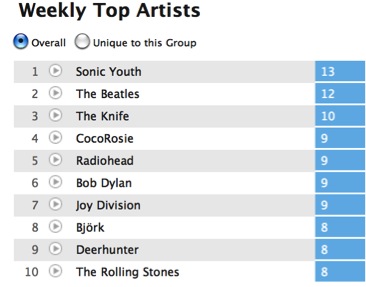
ANIMAL MY SOUL GROUP CHARTS


Pleased that my Animal Soul Group on Last.Fm, which I created on 2nd January 2011, has, to date, a grand total of 88 members.

Thanks to  those who have joined! I love you all!!

What I like about these groups is seeing, and playing, the weekly charts.

The way that overall charts work (edited from the last f.m FAQ section) is that every “1” will represent a group member. For example, say there are 3 people in a group who listened to a certain artist in a given week, it’ll say “3” in the charts .

The first overall chart for the AMS group is quite a solid, conservative list headed by Sonic Youth. The only surprise for me was The Knife at number 3 , an electronic duo from Stockholm, Sweden who I never really rated that much.

The ‘unique to this group’ charts are usually much more interesting. Continue reading

KILL YOUR IDOLS

Kill Your Idols is a film made by Scott Crary in 2004.  It took the prize for Best Documentary at the 2004 Tribeca Film Festival and gained a distribution deal with Palm Pictures.
Under the tag line “the New York No Wave scene and those who followed” it features appropriately grainy footage of gigs from the Hardcore heyday of the late 70s/early 80s . There are clips of  the likes of DNA (a wonderfully geeky Arto Lindsay), Teenage Jesus & The Jerks (one of the best band names ever) and The Swans (Michael Gira in primal mode).

What struck me was the raw physicality of these performances.  More than one interviewee states that the music was secondary – attitude was more important than technique. The driving force was giving vent to the sense of rage and resentment (society is to blame!).  This is probably why so few of the records from that era really stand the test of time. As with the most obvious counterpart of  British Punk in 1976/7  this was something to experience in the flesh. It was  the antithesis of commodified culture.  Eno’s ‘No New York’ of 1978 is the most cited album of this scene but the fact that it only includes 4 bands (Contortions, Teenage Jesus, DNA and Mars) make it an inadequate document. Not including anything of  Glenn Branca’s ‘Theoretical Girls’  is the most  glaring ommission.
In ‘Rip It Up And Start Again’, Simon Reynolds describes No Wave accurately as “a cultural spasm, an extremist gesture, that could only exhaust itself“.

Mercifully Crary’s film doesn’t set out to market the nostalgia factor but to examine the legacy.  One of the main purposes of the film is to comment on the fact that such harsh, dissonant acts inspired and spawned a number of bands working today.  As a result, equal weight is given to the art rock bands like Liars, Black Dice and Yeah Yeah Yeahs  that drew inspiration from these  post punk acts .  Not surprising these are mostly regarded with disdain by the uncompromising Lydia Lunch.

A  particularly tenuous link is that of Gogol Bordello. Their brand of Ucranian Gypsy Punk seems to me to have more in common with bands like The Pogues and Les Negresse Vertes than with Hardcore underground rock. The inclusion is forgiveable because Eugene Hütz  is such a lively speaker.

I hadn’t previously heard of A.R.E Weapons and won’t be rushing out to buy/download their music on what I saw here. Lead vocalist Brain F. McPeck  is a real poseur who bares his well toned torso and his equally ostentatious  ego,  coming across like  the missing link between Jim Morrsion and Spinal Tap.

What is most evident is the massive debt owed to Sonic Youth in the way they took  the energy of No Wave and mixed it with a Velvet Underground dynamic to create a crossover sound without selling out to mainstream taste.  It’s no coincidence that it is they who coined the Kill Your Idols phrase of the title and that Thurston Moore is one the most articulate voices we hear in this film.

At the end of the film, however,  even Moore, in common with other contributers, is lost for words when asked what the next big thing could be to match the cultural impact of the No Wavers.
However, I think it is significant that he and Michael Gira are now both heads of influential record labels (Ecstatic Peace and Young Gods respectively) that promote neo-folk and psych-noise of the New Weird America. This is  to my ears at least one of the truest legacies of  the diy spirit of Punk.  It may be  less overtly threatening and use more than three chords, but this is music which is its equal in terms of authenticity and sincerity.

NO AGE

“I’m guessing this is more of a music salon than a teenage riot place” observes guitarist Randy Randall accurately.

Randall is 50% of LA’s Sub Pop phenomenon No Age. The other half is Dean Allen Spunt who sings and plays drums, neither one with any great aplomb but the fact that he does both together is pretty cool.

The band are playing the Bronson Club near Ravenna which despite being little more than a modest social club has an admirable track record of attracting a steady stream of rising stars and leftfield heroes from beyond the mainstream.

A ‘salon’ is a putting it a bit strongly, but the audiences do tend to be a polite, good mannered bunch and I suspect the No Agers are used to a rowdier reception.

They try gamely to create a rapport with genial chat and during the first number Randall makes a bold gesture to break the performer/punter divide by stepping among us while still playing his riffs. This might have succeeded better had there not occurred a Spinal Tap moment in which he fell flat on his face while re-mounting the stage.

Further attempts at genuine ice-breaking floundered in similar fashion. Realistically a Monday night audience numbering around 40, most of whom don’t speak Californian, is not one where there much hope of whipping up a party atmosphere.

Blunt and Randall impress as a likable duo nonetheless and sound like Psychocandy kids raised on a diet of drone-noise and punk rock. Imagine the music the offspring of Joey Ramone and Sonic Youth’s Kim Gordon might play and you’ll get the idea.

Their best songs – Boy Void, Everybody’s Down or Eraser to name just three – are spiky and snappy pieces with a refreshing absence of indie boy band pretensions.

It’s easier to imagine them busking on a street corner than playing bigger venues and this alone ensures that the DIY punk spirit has made it through to another generation.


tumblr_lyr0dnvdnb1qkm7avIf any musician epitomises a modern version of America’s pioneer spirit, it is John Fahey. Since his death at the age of 62 his reputation has continued to grow and his back catalogue of recordings dating from 1958 still baffles, intrigues and delights audiences.
In a tribute in The Wire (June 2006), David Keenan wrote :
“Right until death in 2001, Fahey continued to move forward, to follow the dictates of the spirit and the demands of his own voice – at times in open contempt of the bulk of his audience – and the result is a body of work that remains inviolable to passing contemporary modes and styles”

Fahey was born on 28th February, 1939 and taught himself to play acoustic guitar and to develop a style which he himself defined as ‘American primitive’ The word ‘primitive’ was also chosen deliberately to link him with self taught French ‘naive’ painters like Henri Rousseau.

Rousseau disregarded the European orientated art school tradition in favour of works which had an affinity with the art of children. His paintings were not technically perfect and relied heavily on an instinctive or imaginary representation of the world. Roger Cardinal, writing in a book on Naive Art, said “the logic of the primitive lies in his adoption of his own code, his own frame of reference” . This is a statement that also applies well to Fahey.

For Fahey, a significant advantage in applying this label was that it dissociated him from the folk revivalists, musicians whom he dismissed as being over sentimental and phoney . He preferred his playing to be seen not as ‘folk music’ but as classically influenced suites and symphonies.

Both Fahey’s parents were amateur musicians so he was exposed to classical music such as Rachmaninov from an early age. This influence merges with that of the old-time and blues recordings he sought out as an avid collector, particularly those of Charley Patton. Through the steel string acoustic guitar, Fahey copied the styles he heard with the aim of making the instrumental passages central rather than for them to be simply backing music. The result is highly individualistic style which is both distinctive and innovative.

The awareness that his sound was at odds with popular taste of the time doubtless prompted the creation of a fictitious mentor, an alter ego who took the form of an old Negro street blues guitarist by the name of Blind Joe Death. On ‘The Legend of Blind Joe Death, 1958’ – for which 100 copies were printed when Fahey was just 19 years old , one side is attributed to Fahey and the other to Death. He continued the hoax for his second album (‘Death Chants, Breakdowns & Military Waltzes’) where part of the liner notes state that “Fahey made his first guitar from a baby’s coffin and led the old blind Negro through the back alley and whorehouses of Takoma Park in return for lessons“.

It is likely that part of his thinking was that listeners might be able to relate to the ‘discovery’ of an obscure bluesman more than to such a young man playing in an old unfamiliar style. Fahey also took perverse pleasure in duping the folk-blues music establishment.

The need to dream up and maintain a prank like this gives a window into the character of Fahey, by all accounts a stubborn and , at times, cantankerous man driven by, but also tormented by his demons. The restlessness of spirit is always a double-edged sword in terms of creativity, leading to a debilitating struggle with alcoholism but at the same time firing the questing nature that ensured he never felt satisfied with his achievements.

It is this which gives his recordings a dynamic sense of crispness and stimulated a constant willingness to experiment with sound and texture. These qualities have ensured the longevity of his music and gained a new generation of admirers such as Cul-de-Sac’s Glenn Jones , Jim O’Rourke, Sonic Youth and The No-Neck Blues Band.

A largely lacklustre tribute album curated by M.Ward in 2006 (‘I Am The Resurrection’) confirms his influence on New Weird artists with contributions from Devendra Banhart, Sufjan Stevens among others.