Tag Archive: Sight & Sound


LE MÉPRIS (Contempt) directed by Jean-Luc Godard (France 1963)

 “Film is strange – show women a camera and they show their behinds”.

This observation by Paul Laval (Michel Piccoli) may be flawed as a universal law of cinema but clearly has an element of truth in the circles Jean-Luc Godard moved in during the sixties.

To prove the point,  the archetype auteur begins the movie with Brigitte Bardot as Camille stretched out languorously on a bed, stark naked, running through an inventory of her body parts to check that Paul, her husband, admires them all – feet, ankles,knees, thighs, buttocks, breasts, nipples, shoulders, arms, and face (mouth,eyes,nose & ears).

Do you think I'm sexy?She could have saved him and us a lot of time by asking the last question first – “Do you love me totally?”
After having given his unconditional approval of her anatomy, he assures her that his love is absolute:  “I love you totally, tenderly, tragically”.

This scene was tagged on at the end when the producers complained that audiences needed to see more unclad shots of Bardot  – suggesting that she wasn’t chosen purely for her acting ability! Continue reading

Bresson’s donkey work

AU HASARD BALZATHAR  directed by Robert Bresson (France, 1966)

How you feel about the film depends a lot on how you feel about donkeys. I have fond memories of rides on the beach as a kid  but otherwise I don’t have much affection for these stubborn and docile creatures.

At the same time, I don’t derive any pleasure from watching scenes the movie’s animal protagonist is burned, whipped, thumped, shot at and subjected to slave labour.

This systematic cruelty and persecution, which  is influenced by Dostoevsky’s The Idiot, is why the film is widely read as a biblical allegory. The fact that Bresson was a Catholic and makes other references to the deadly sins endorse such an interpretation.

The other main thread of the film is the life and loves of Marie who is more sinned against than sinning and is also ill-treated by men. Part of this is her own doing as she chooses the reckless and rebellious Gerard as a lover instead of the more reserved Jacques.

Bresson had a reputation for tortuous rehearsals where he made actors repeat their lines until they were heartily sick of them. He wanted to avoid an overly theatrical dimension to their performances but the result is a series of wooden, emotionally detached dialogues. When the characters talk of love and fear they may just as well be comparing shopping lists.

On top of this, the French director also has an unconventional approach to narrative. While the story broadly follows a linear path there are times when it seems that whole scenes are missing. For instance, we see the police pick up suspects for a murder investigation but we never find out who has been killed!

Such quirky aspects of the movie are praised as Brechtian devices that disrupt and challenge passive viewing. With surreal movies like those of Bunuel or Lynch touches like this are effective in creating a disorienting and/or creepy mood but in this movie, which otherwise has the look of a neorealist drama, they seem to be obtuse for the sake of it.

You won’t find many negative reviews of this movie online, on the contrary you will encounter practically unanimous acclaim. Jean Luc-Godard praised it as a representation of “life in an hour and a half”, it scores 100% at Rotten Tomatoes and was voted by BFI/Sight & Sound as the 16th greatest movie of all time.

I must beg to differ as I found it both boring and uninvolving. I would only be prepared to concede that it is the best French film ever made about a donkey.

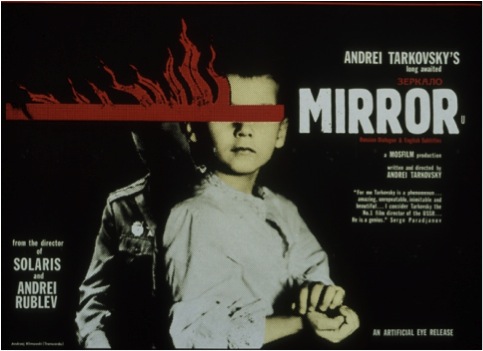
REFLECTIONS ON MIRROR

MIRROR directed by Andrei Tarkovsky (Russia, 1975)

Tarkovsky’s movie is an enigma without solution – a poetic reflection on memory, regret and death that has no defined beginning, middle or ending.

It’s power rests on the dream-like visuals  where recurring images of  wind, fire and water appear to be deeply symbolic but remain open to interpretation.

We see wartime newsreel footage, hear music by Bach, the voice of a hidden narrator and poetry read  by Tarkovsky’s father. It spans three different time periods with no obvious link or linear narrative to connect the scenes. Continue reading

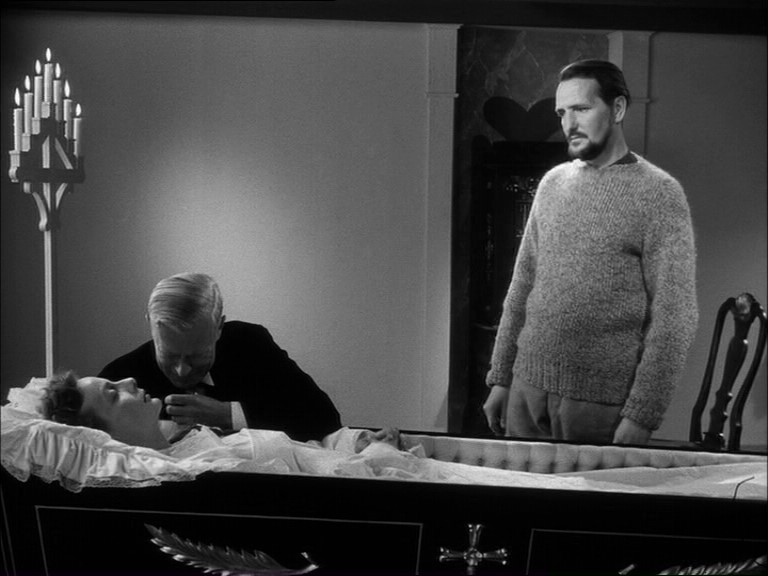
ORDET directed by Carl Theodor Dreyer (Denmark, 1955)

It gets harder and harder to keep an open mind about arts and culture but I can honestly say that I approached this movie with no preconceptions.(If you plan to see it in the same state of blissful ignorance, look away now as this post contains spoilers!)

The only thing I knew about it was that it had been placed 24th  in the BFI/Sight & Sound list of greatest films ever made. Regular readers of this blog (if such beings exist!) will know by now that I have set myself a goal of seeing all of the top 50 films on this list (I still have 14 to go!)

While I marvelled at  Dreyer’s Jeanne D’Arcy, I can’t say I was as thrilled by the Dane’s Ordet, a title which translates as ‘The Word’ as in ‘the word of God’. Continue reading

CLOSE-UP (نمای نزدیک‎, Nema-ye Nazdik) directed by Abbas Kiarostami(Iran, 1990)

This movie is a reenactment of a true story in which all the parts are played by the people who were involved in the ‘real life’ events.It tells of a man, Hossein Sabziam,  who assumed the identity of  popular Iranian director Mohsen Makhmalbaf and gained access to a home of the well to do Ahankhahon family on the pretence that he wanted to use the house as the location for his next film.

While it has some of the characteristics of a documentary, the fact that we are not presented with a linear narrative is just one aspect that illustrates that the film should be judged as a work of art rather than as mere reportage.

It begins with a reporter in a taxi on the way to the address where he anticipates a big scoop. In the back of the car are two policemen (“Don’t the police have their own cars?”, asks the cabbie).

The reporter doesn’t know where the house he is looking for is. He asks some passers-by . One old man doesn’t know but offers to sell one of the two live turkeys he is carrying instead. Eventually, they find the address which is in a no through road. “It’s ironic that my big story should be in a dead-end”, comments the journalist.

A bumbling reporter, a bored cab driver and the police as back seat passengers all give the impression that we are about to see a comedy rather than a drama. Yet while there is an element of farce about the plot, any humour is understated.

When Sabziam is exposed as an imposter, he is arrested and tried for fraud. We then see how the film director persuades the judge to allow cameras into the courtroom to show what happens during his subsequent trial.

The main body of the film interspersed with scenes (mainly in close-up) of Sabzian being cross questioned and the circumstances that led to his arrest.

Far from coming over as a man with any evil motives, he is a sad figure who finds solace in art and a love of cinema in particular. He describes how he impersonated Makhmalbaf  simply because he identifies so completely with the man’s work, especially a movie called The Cyclist. He comments that he finds greater consolation in these films than praying to Allah or studying the Koran, a statement that I imagine was greeted with some controversy in Iran.

One of the family accuses him of playing the part of a sensitive soul to get the sympathy of the judge – “I’m speaking of my suffering, I’m not acting”, Sabzian maintains and we believe him.

His punishment of a short prison sentence is relatively mild after the family are eventually convinced that he had no ulterior motives beyond wanting to see how it felt to be a somebody, rather than a man with a menial job as a print worker.

When he is released, he is met by the real Makhmalbaf , an encounter that seems to have been set up for the benefit of the movie. If so, it is a justified fabrication as it makes for a touching finale. We see the two men riding on a motorcycle with Sabzian clutching a bunch of flowers which he takes to the Ahankhah’s home as a final apology for what has happened; and the family finally get to meet the real director as an added bonus.

The movie has been acclaimed as a masterpiece by critics. In a Sight & Sound poll it was voted as one of the 50 greatest films of all time. Personally, I wouldn’t rate it so highly although I recognise its integrity and authenticity  and there is much to admire the restraint with which Kiarostami presents a story that could have been played for laughs or presented as a cheap melodrama.

The director has been quoted as saying, “We can never get close to the truth except through lying” and therein lies one of his key motivations for making this fine movie.