Le journal d’une femme de chambre,(Diary of a Chambermaid) directed by Luis Buñuel (France, 1964)
 I am currently fixated on rediscovering the fascinating filmography of Luis Buñuel and the path back from The Discreet Charm Of The Bourgeoisie leads to Diary Of A Chambermaid.
This was the first of the Spanish director’s fruitful partnership with screenwriter Jean-Claude Carrière and the first of the French period of his final movies.
For lovers of surrealism it doesn’t offer many rich pickings as it tells the story in a relatively conventional manner.
It centres on a sophisticated Parisian chambermaid Célestine (Jeanne Moreau) who begins work for the Monteil household at a country château. There she finds herself working for a fastidious and frigid wife and having to contend with this woman’s frustrated and frisky husband.
The most Buñuel-esque scene is that between Célestine and wife’s elderly father where the old man reveals a fetish for shoes. He gets her put on a pair of boots and has her hitch up her skirt so he can watch her walk around his room. When he is later found dead in his bed he is clutching these same boots so you are left to presume that the excitement proved too much.
The adaptation of Octave Mireau’s novel is otherwise rendered as a kind of dark fairy tale where the wolves are hairy on the inside and where the rise of European antisemeticism is pointedly linked to the bigotry and hypocrisy of priests and the middle classes.
This may be one of Buñuel’s minor works but it is fascinating all the same and well worth seeing for the subdued sensuality of Jeanne Moreau’s performance.


 This movie begins with stock footage of
 Any doubt that religion is the prime target is dispelled by the closing sequences where we see a Christ-like figure leaving a sadistic orgy to the sound of tribal drumming and an image of a crucifix decorated with women’s scalps as jolly music plays. If ever there was a film that was made to be banned, then this is it. Salvador Dali and Buñuel could not realistically have expected official endorsement for the manner in which they show such wanton disrespect for bastions of the establishment and the catholic church in particular. It was made in 1930 and it was not until 1979 that it received formal premiere in the U.S. Better late than never.
 Perhaps I should temporarily rename this blog ‘Buñuel My Soul’ as I’m currently immersed in the movie back catalogue of the great Spanish director.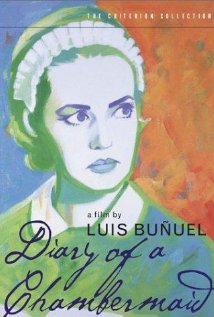
 There are plenty of films where women are badly treated by men but in this movie it is the man who is a victim of sorts and , like all the best farces, it has a tragic aspect.