
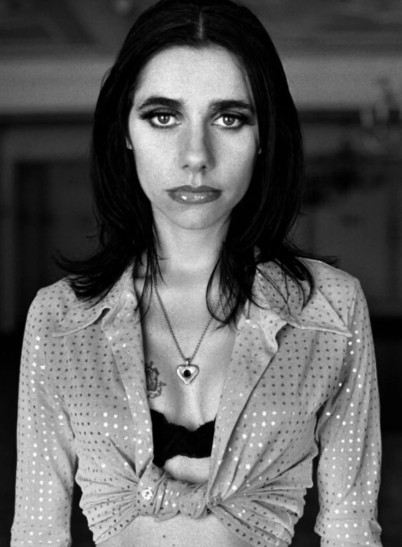
On P.J. Harvey’s debut single, she mocked the human mating rituals that force women to wear clothes that are hard to walk in and make them feel they are “spilling over like a heavy loaded fruit tree”.
‘Dress’ was the song my friend Tim had heard on the John Peel show. On the strength of it he and I went to see her play a support slot at Camden Town’s Borderline club in 1991.
She was good and original but I wouldn’t have guessed that 16 years later she’d still be making albums of the highest quality. How wrong can you be?
With the benefit of hindsight, I think you can see that her durability is down to fact that she never allows herself to be pigeonholed as just another feminist orientated rock chick. She was her own woman right from the outset, whether posing nude on the cover of NME or dressing like a Hollywood vamp for the video of ‘Down By the River’, she always seemed to be mocking the stereotypical representations of women while getting pleasure in the role playing.
Mostly this came across as spirited male baiting rather than venomous man hating. The songs had the the same irony/ cynicism that prompted a cool punkette I saw at that Camden gig to wear a T-shirt emblazoned with the arresting slogan ‘Fuck Me And Marry Me’!
The strident sexuality of Polly Harvey’s songs has been a key thread throughout her career. She depicts female desire as something raw and sometimes discomforting. The results are so totally devoid of cliché or sentimentality that they are often startling. On the title track of her second album, Rid Of Me she famously screeched “Lick my legs, I’m on fire” with a kind of unbridled lust that nice girls are not supposed to even think of let alone holler about.
Harvey has always denied autobiographical content but there’s surely something within her personality that draws her to write about sex in this way and the way she is drawn to write about tortured souls like ‘Angeline’ on ‘Is This Desire’ who is introduced to us as “the prettiest mess you’ve ever seen“.
By the time P.J. Harvey released her 7th album ‘Stories from the city, Stories from the sea’ , audiences were beginning to catch up with her. The result was that she had the dubious pleasure of staring mainstream success in the face. The Mercury Prize for this album was in recognition for a strong set of songs but also a reflection of the fact that this was also her most accessible, radio friendly material to date.
With this critical and commercial endorsement behind her she could easily have churned out more ‘stories’ in a similar vein. Thankfully, this is not her style. She’s a woman who needs to continually set herself challenges. The deliberate rough and ready quality of ‘Uh-Huh Her’ was an attempt to get away from an overly sanitised sound but, while it had its moments, it also sounded a bit forced.
All the more surprising and satisfying that we now have the ghostly and triumphant ‘White Chalk’, an album of such power and clarity that it may well be the finest of her career. Her recent collaboration with Marianne Faithfull on the fine ‘Before The Poison’ album seems to have regenerated Polly to the point that she feels confident enough to release a record as bold as this.
It most resembles the sombre and brooding quality of ‘Is This Desire’ but what sets it apart from that ,and all her previous releases, is that she has forsaken electric guitar for the piano. She does not claim to be an accomplished pianist she clearly knows enough to convey the mood of sadness and longing that dominates the record.
There are 11 short tracks with a total playing time of just 34 minutes so we’re talking quality rather than quantity here. For a record of such intensity the length is just about right. There’s nothing extraneous here and the reflective tone can be gauged by a few snippets of the lyrics:
“I pretend to myself” (The Devil);
“Teach me, mummy, how to grow“(Grow Grow Grow),
“Conscious of nothing but the will to endure” (When In Ether)
“Tearing my stomach out if you think ill of me” (Broken Harp)
Polly Harvey is still very much an enigma – a polite, softly spoken West Country girl who in performance seems to draw upon a depth of emotional yearning. Her songs are steeped in the old time blues tradition but fiercely contemporary.
White Chalk is a document of a woman looking inward with an unflinching eye and who is not wholly sure if she likes what she finds there. The track ‘To Talk To You’ is dedicated to the memory of her grandmother and the sense of loss is present throughout the album. The moaning banshee wails that close the album suggest that Polly has confronted her demons but is some way from exorcising them.
It is the uncompromising manner with which she faces up to the dark clouds of doubt, isolation and melancholy that make this album so rich. Like Bonnie ‘Prince’ Billy’s masterful ‘I See A Darkness’, it has the purity of an artist unafraid to delve into the recesses of the mind without feeling the need to report back any glib, everything’s gonna be all right, conclusions. As a result, there’s no sense of closure – how could there be? – the only glimmer of consolation comes from the “human kindness” she refers to on ‘When In Ether’. The message seems to be that if we are honest with ourselves this is the most we can wish for.


