Of all the recent noise-ambient artists that have surfaced over the past decade, Yellow Swans based in Portland, Oregon stand out as something special, taking the experimental into transcendental realms. An example of their genius comes on their recent limited edition release (’Drowner Yellow Swans’) – at a magical point near the end of the track ‘First Drowner’ , the wave of distorted sound and feedback subsides so you hear what sounds like muffled cries from a distant school playground. None of the cries are distinct, they seem human but it is impossible to identify any specific words or place the age or gender of those making the sounds. I found listening to these familiar yet ‘abstract’ sounds moved me in a way that is hard to put into words.
 I first came across Gabriel Mindel Saloman (GMS) and Pete Swanson, the duo that make up the ‘band’, through the release of the superb ‘Psychic Secession’ in 2005.
This album made me rethink noise not just as a post-rock offshoot of punk or industrial music but as having a lot in common with modern classical works like Henryk Górecki’s Symphony No.3 , Avro Pärt’s ‘Tabula Rasa‘ or Morton Feldman’s ‘Rothko Chapel‘ .These are meditative works that transport the engaged listener away from intellectualised responses and onto a spiritual plain.
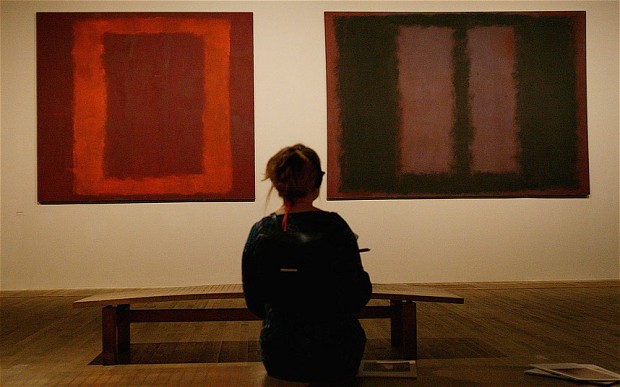
I also think there is a parallel between this type of experimental music and the works of iconoclastic visual artists like Mark Rothko and Jackson Pollock. Both post impressionist artists and noise manipulators are essentially trying to bypass rational thought processes and communicate directly to the unconscious mind. Crucially, both are founded on the principle that creativity cannot, and should not, be confined within pre-established boundaries or neat structures. Many creative insights come from spontaneous thought, capturing transient ideas and fleeting moments of inspiration when control is lost .
British sculptress Barbara Hepworth helped in appreciating the key emotional differences between working on realistic and abstract compositions when she said: :“Working realistically replenishes one’s love of life, humanity and the earth. Working abstractly seems to release one’s personality and sharpen the perceptions, so that in the observation of life it is the wholeness or inner intention which moves one so profoundly: the components fall into place, the detail is significant to unity” .
Modern art critic Herbert Read called this a “psychic shuttle” abstraction , which he defined as meaning that which is “disengaged from nature” and realism.
The impulse towards improvisation that drove artists like Jackson Pollock is mirrored in the raw energy of Noise Rock and the restless spirit of Free Folk. Inevitably, and quite deliberately, these sounds challenge the notion of music as a source of solace or reassurance. Instead, the often disorienting musical language attempts to replicate the experience of modern living as an alienating mix of chaos, confusion and dread.
In a Wire interview, GMS of Yellow Swans said: “[People] have to literally change their mind, and in so doing begin conceiving of relationships with themselves and others that have no pre-existing structure”.
I urge you to give ‘Drowner Yellow Swans’ a hearing as it sums up all that is great in the Yellow Swans sound – electric, primitive and mysterious but also inspirational.