Tag Archive: john lennon


This post is the second of two assignments for the UC, San Diego ‘Learning How To Learn ‘ MOOC on Coursera presented with skill and enthusiasm by Dr. Barbara Oakley and Dr. Terence Sejnowski.

If you are here as a peer assessor, be gentle with me.

If you are a casual reader, you are one of my target audience and I hope you learn something about learning how to learn from this post.

Learning to Learn

On the sound principle that you learn best by doing, and sharing, the task is to present three of the main points as if teaching them to others. Continue reading →

SILENCE. LECTURES AND WRITINGS BY JOHN CAGE (Marion Boyars Publishers Ltd, 2009)

718brsgdxzl._sx355_bo1204203200_I have just marked this book as ‘read’ on Good Reads but I confess that I have not read every word, sentence or line .

I doubt whether there are many that have.

This is a source book.

A book to dip into.

If you attempt to read it form beginning to end your brain will hurt.

This is not a story and there is nothing linear about the text.

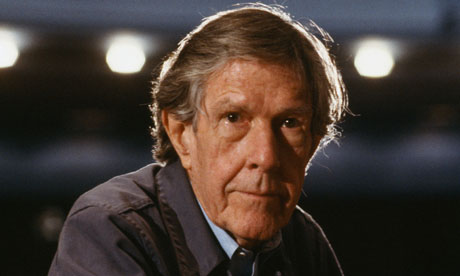
John Cage was not a conventional musician and not a conventional thinker. He knew the limitations and possibilities of sound and the difficulty of explaining what music was and/or what it was for.

John Cage

John Cage

He wrote that “the way to get ideas is to do something boring”.

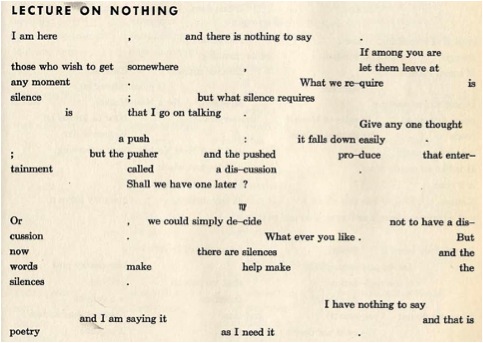
He didn’t pretend that his lectures  were interesting. His lecture on nothing comes with the warning:  “The text itself is repetitive and at times excruciatingly boring”.

Creativity is what happens between doing or thinking about something and nothing. It’s a Zen thing.

In Darling Boy (Beautiful Boy) John Lennon sang “Life is what happens to you while you’re busy making other plans”.

He begins his  Lecture on something: by saying : “This is a talk about something and naturally also a talk about nothing. About how something and nothing are not opposed to each other but need each other to keep on going”.

Opening text to Lecture On Nothing.

Opening text to Lecture On Nothing.

He begins his  Lecture on Nothing: by saying;  “I have nothing to say and I am saying it and that is poetry”

He liked asking questions but one of these was ‘Is it true there are no questions that are really important?”

The final talk in this collection is entitled ‘Where Are We Going? And What Are We Doing?‘ but don’t expect to find the answers in the text.

Many may regard this as pretentious and deliberately obtuse – two of many criticisms levelled at Cage.  It was suggested that Cage would shock people more if he gave a conventional talk, to which he replied : “I don’t give these lectures to surprise people but out of a need for poetry”.

He composed his talks like he was giving a musical performance so the timing of the delivery was often as important as the words. They were meant to heard and not read so the book attempts to replicate the character and shape of each lecture. For example, a lecture on ‘Indeterminacy’ is  written in extremely small type “in an attempt to emphasize the intentionally pontifical character of this lecture”.

It is not an easy read but it contains a wealth of ideas and it’s a book I continually pick up much as believers might pick up a bible looking for revelations or insights from a random choice of text.

The debt modern musicians owe to Cage is enormous even if they have never heard his music OR listened to / read his lectures.  His experiments with sound were dismissed as the actions of a lunatic but today samples, tape loops, field recordings, random noise , programmed beats and the use of ‘non musical’ instruments are commonplace.

As I said, the talks were meant to heard and Ubuweb has many valuable sound archives that illustrate the point. For instance it is interesting to compare two recordings of Lecture on Nothing.

One is performed by  Frances-Marie Uitti From the album  “Works for Cello; Lecture on Nothing”, (EtCetera Records, 1991)

The other is by Kaegan Sparks with ambient noises of Christian Marclay

THE POWER OF NOW: A GUIDE TO SPIRITUAL ENLIGHTENMENT by Eckhart Tolle (New World Library, 2004)

A book like this wouldn’t have become such a best seller without it containing a modicum of truth and wisdom.

Ekhart Tolle has won high-profile fans in the form Oprah Winfey, Jim Carey and Meg Ryan as well as hundreds of enthusiastic endorsements on Amazon, exemplified by one who gushes: “I have no words to describe how profoundly this book has changed me AND my life. This book is unbelievable!. I was mesmerized by every word … AWESOME! Whewwwww!”

I think it is hard to argue with statements like “every addiction starts with pain” and I am willing to go along with the notion that we should live more in the moment rather than dwell on what might have been or what might be.

As William Henry Davies wrote in his poem, Leisure: “A poor life this is if full of care, we have no time to stand and stare”. The accelerated lives we lead means that, more than ever, we need to give ourselves time and space to take stock of where and who we are.

But to turn all this into a spiritual teaching is over egging it a bit. Tolle’s guru qualifications are very flimsy. His epiphany came during a sleepless night at the age of 29 after which he overcame his suicidal tendencies with a realisation that nice things happen when you just stop thinking. This might have been an excuse to overdose on daytime TV but he decided that becoming a spiritual leader was better career move. Continue reading →

THE BEATLES’ MAGICAL MYSTERY TOUR REVISITED  BBC Two.

Fabs MysteryOn this Arena special, it was good to get another chance to see the complete TV film of The Beatles’ Magical Mystery Tour. A  documentary, containing interviews and behind the scenes footage, was also illuminating in helping to put the film in a social and historical context.

The last time I saw the film in its entirety was when it was first broadcast (in black and white) on Boxing Day in 1967. I was just eight  years old at the time so had only a vague memory of it.

I was too young to pick up on all the LSD inspired images but old enough to realise that it had what one of the film’s extras describes as “disconnected shots of weird things”.

What I do vividly recall is the scene with a stripper while The Bonzo Dog Doo Dah band are singing Death Cab For Cutie. The sight of bare breasts on a prime time TV slot at Christmas made a big impact on me.  My parents, who were also watching, were less impressed!

This is why I can endorse Ian Macdonald’s view, in his book Revolution In The Head, that: “Magical Mystery Tour marks the breakdown of the cross-generational consensus ………this is where parents began to part company with their sons and daughters over the group, rightly suspecting a drug-induced persuasion setting in” Continue reading →

FROM ZERO TO LESS THAN ZERO

THE KILLING OF JOHN LENNON directed by  Andrew Piddington (UK ,2006)

mark chapmanI’m sure there are many who think this movie should never have been made.

It’s a high risk venture to attempt any form of dramatisation of this tragic event. There’s a real risk that any attempts to understand the motives behind the cowardly murder will give slimeball Mark David Chapman added notoriety and the kind of infamy he craved; he was quoted as saying “I was Mr Nobody until I killed the biggest somebody on earth”. Continue reading →