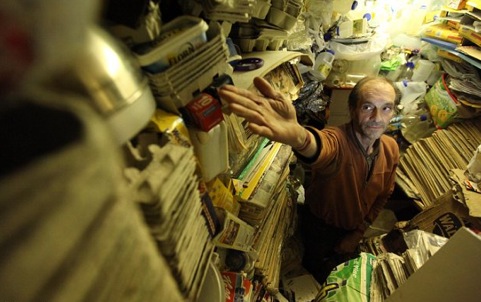
Make yourself at home! – Richard Wallace of Westcott.
I’ve just watched two revealing documentaries in successive nights on the topic of hoarding – Obsessive Compulsive Hoarder on Channel 4 and BBC’s Britain’s Biggest Hoarders.
These are extreme makeover shows where we are afforded the luxury of eavesdropping on the mess of other people’s lives and can thus feel marginally better about ourselves.
What’s clear is that there’s a fine line between collecting and hoarding, between being thrifty and stockpiling useless junk. ‘You never know when it might come in useful’ is probably one thought that initiates the obsession. If you’re not careful this can become a slippery slope where you are reluctant to dispose of anything.
Alan, a hoarder from St Albans on the BBC programme, was reluctant to part with a collection of clothes hangers on the basis that he didn’t want to go out and buy wire if he needed it.
I once knew someone who never threw away old copies of Radio Times, a collection that took up a lot of space in his garage. I myself have a ‘collection’ of cassettes and video tapes I’ll probably never listen to or watch again.
Newspapers and magazines in general appear to be items people like to cling on to but my conscience is relatively clear on this score.
Jasmine Harman the likeable presenter of the BBC documentary says that hoarding is not recognised as a psychiatric disorder; a statement slightly undermined by her being able to call upon Dr Caroline Weiss (“a psychiatrist trained in treating hoarders”) and Dr Paul Salkovskis (“one of Britain’s few hoarding experts”).
More practical help came in the shape of Heather Matuozzo who is introduced as a “professional declutterer”. Continue reading