Tag Archive: anorexia


THE VEGETARIAN by Han Kang (Hogarth Books, 2015)
vegetarian-208x315

By turns surreal and nightmarish, this is a short but complex novel which is full of secrets.

In very broad terms I would describe it as a book about descending into silence and , quite possibly , incurable madness.

The main character is Yeong-hye who is, by all accounts, an unremarkable woman. In the words of her brother-in-law: “The only thing that was especially unusual about her was that she didn’t eat meat”.

Her husband is beyond himself with a combination of rage and repulsion over his wife’s sudden change in eating habits. Her father turns to violence and attempts to force feed her meat. She tries to kill herself and is eventually institutionalized. She gives the impression that she would be happy to die and/or become a tree. Continue reading

THIN directed by Lauren Greenfield (USA, 2006)

Brittany struggles to find reasons to be cheerful.

Brittany struggles to find reasons to be cheerful.

There’s never been a better time to have an eating disorder. As long as you have access to the Internet, and who doesn’t these days?, you don’t need to feel you’re alone anymore.

The fasting, bingeing and purging are still sad, solitary activities but at least now you get the chance to share techniques and strategies online or read and watch others engaged in similar practices.

Pro Ana and Pro Mia websites promoting and discussing anorexia nervosa and bulimia nervosa respectively are on the rise. So-called ‘thinspiration’ photos circulate as motivational body images.

Many of the blogs, forums and articles pitch these conditions as lifestyle choices rather than as problems, a dangerous trend in my view given that the negative effects on health and happiness have been so well documented.

I have more than a passing interest in this subject because my teenage daughter has an eating disorder that swings unpredictably between ‘ana’ and ‘mia’. Fortunately, she doesn’t see this as anything to be proud of and would like to change. She’s the one who recommended ‘Thin’, saying that she liked the way it shows the reality of the conditions in a non-preachy or judgemental style.

Lauren Greenfield’s film is a fly on the wall documentary set in Renfrew Center, Florida. The staff at this institution are clearly not chosen as models of fitness; a high percentage are clearly overweight or even obese which probably makes many sufferers even more determined to maintain their crash diets. Also, the food served up this institution looks so fatty, stodgy and generally disgusting that I think I’d be half inclined to join them. Continue reading

All shapes and sizes

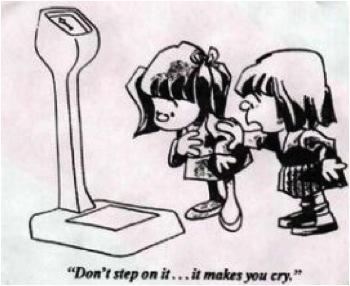
Some girls are bigger than others.

Teaching teenagers is tough. They are neither children nor adults. They think they know everything but still need guidance and advice about growing pains and general insecurities.

Schools have a responsibility to show sensitivity and respect towards these inbetweenies. They also have to be careful about choosing appropriate topics for discussion in the classroom. Sex, politics and religion are the most obvious subjects that need to be handled with care. But there are others.

Today,  in my daughter’s French language class,  the teacher started talking about obesity and anorexia. She spoke in Italian so there was no linguistic content. Why she felt the need to raise this topic is a mystery, I suspect she was just filling in time at the end of a lesson on the general topic of food. The effect of her ad-hoc discourse was to provoke expressions of revulsion and disgust which made my daughter feel exposed and deeply uncomfortable.

Happy teenagers.

You see, she has an eating disorder and ,what’s more, the teacher knows this. I won’t go into details, suffice to say that my wife and I take her problem seriously and are seeking solutions through professional carers. It’s a slow process and we have learnt enough to know that there are no quick fixes.

She is not a solitary case, many of her age, girls especially, have serious worries over their shape and size – comparing themselves with images of ‘perfect’ bodies  on TV, in movies and magazines only makes things worse.

In my opinion, teachers in high schools should not use this topic in classroom discussions and, above all, they should avoid asking the type of questions recommended on one website for teaching kids :

  • What causes some people to develop eating disorders?
  • How do people with eating disorders feel about their bodies?
  • Does the person they see in the mirror always match reality?
  • How might an eating disorder affect a person’s family and social life?

These are all good questions but sufferers will not feel comfortable talking about in a group which is not there to offer support or comfort.

Parents have every right to expect educators to be more sensitive to delicate issues than the mass media and teachers have to recognise that they are not psychologists or health advisers.

“In the USA anorexia is the third most common chronic illness among adolescents”. This is one of the disturbing facts in an article on ‘body-bashing’ in Teenvogue.

It’s ironic to find a piece like this in a magazine which is part of the problem rather than the cure. Elsewhere in the mag there are skinny models, endless makeup tips and a tons of advice on “love, life and fashion”.  It’s the height of hypocrisy to pretend to be surprised when teens get so frantic about their physical appearance. Continue reading