
LEARNER EXPERIENCE IN MOOCS

This is my assignment for activity 14 of the Open University’s ‘Open Education (#h817open) course in which I look at how MOOCS have been defined and compare the Direct Storytelling courses (ds106) with those provided by Coursera.
DEFINING MOOCS
The MOOC acronym was coined in 2007 by David Cormier and Bryan Alexander to describe the University of Manitoba course ‘Connectivism and Connective Knowledge’. This attracted less than 3,000 students so was, by some degree, less massive than more recent online courses.
Some have argued that the monolithic nature of MOOCs now depersonalises them to the point that they can only pay lip service to the principle of ‘connectivity’ and makes the use of the adjective ‘open’ a bone of contention.
An example of the backlash can be found in Reclaim Open Learning, a network which prefers to talk in terms of “small pieces, loosely joined’ rather than an unwieldy and impenetrable mass of resources.
Sir John Daniel’s paper on Making Sense of MOOCs looks at the history of online courses and sets them in a wider educational context. He talks a lot about the intense media interest surrounding them and even goes so far as to refer to them as ‘fads’.
Daniels makes a distinction between cMOOCS and xMOOCS yet, irritatingly, doesn’t bother to define exactly what he means by these terms. Elsewhere, I found the following definitions:
- “cMOOCS are discursive communities creating knowledge together”
- xMOOCS are “based on the teaching model where the teacher teaches, and the students learn and consume the knowledge”
The fundamental difference is between active and passive learning activities; a process neatly represented by these two diagrams where the image on the left represents the x-model and that on the right shows the connectedness between learners
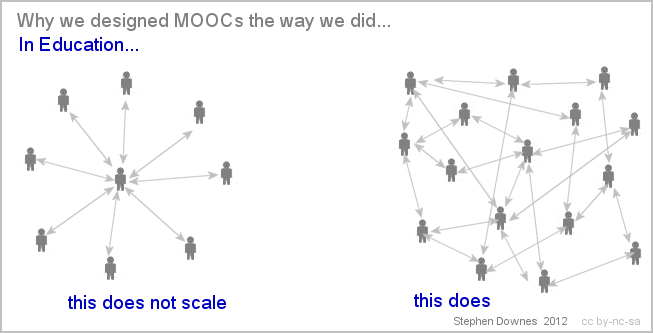
Daniels implies that he doesn’t believe MOOCs in their current form will survive long and writes that “the discourse about MOOCs is overloaded with hype and myth while the reality is shot through with paradoxes and contradictions”. Much of his scepticism derives from the high level of dropouts and the fact that nobody seems to be sure how to generate income from these online courses. He does, however, concede that it is too early to draw any definitive conclusions.
My first brush with MOOCs was The University of Edinburgh’s E-Learning & Digital Cultures (edcmooc) on Coursera. This was such an enjoyable and informative course that I find it hard to share Daniels’ grumpy attitude.
I liked the fact it seemed as if it was as much of a learning experience for the organisers as it was for the participants. Jeremy Knox of the Edinburgh team describes MOOCs as “an emerging pedagogical mode that is significantly under-theorised” which I suppose is academic speak for ‘the jury is still out’ with regard to their long-term potential.
Elsewhere, we hear a lot of course designers talking in terms of MOOCS as online ‘events’ and ‘offerings’ – the first suggesting they are something akin to a 60s-style ‘happening’, the second making them sound like gifts for the masses.
DS106
To digital immigrants like me, Direct Storytelling (DS106) looks very daunting indeed. I feel immediately that I am in a place where those who have grown up with technology are looking to show off their expertise and creativity to the world.
Although the organisers describe it as an “open, online course” it is arguably neither a ‘c’ nor an ‘x’ MOOC. There are no lectures or prescriptives; the brains behind DS106 imply that ‘open’ means that nobody is really in charge. It’s a digital Fight Club – the only rule is that there are no rules.
I can see that something important is happening here but, like Dylan’s Mr Jones. I don’t exactly know what it is.
What it is most assuredly NOT is a traditional educational resource where the teachers and learners roles are fixed.
There are recommended “tools for the trade” but how these are used is entirely up to course participants. It is like a classroom full of materials where students are let loose to express themselves. Those enrolled are encouraged to “frame identity in their own way”, to avoid repeating what others have done and to create something new, bold and original.
But you don’t just do the work. You also have to tell the story behind what you have done. rather like a movie director talking about why she chose a particular shot, soundtrack or type of lighting.
COURSERA
I feel on much safer ground with Coursera. It has obvious appeal to people like me who were brought up, some might say indoctrinated, by traditional learning methodologies.
The philosophy is determined by established educational institutions. Courses utilise a patriarchal pedagogy designed to “help learners learn the material quickly and effectively”.
The website invites surfers to be awestruck by the wealth of courses on offer and by the prestige of the top universities partnering the company, 62 at the time of writing. And, make no mistake, it is a very impressive list. I recall the first time I searched the site, wondering what the catch was.
The courses offered through Coursera show that making distinction between cMOOCS and xMOOCS adds a level of complexity which serves no useful purpose.
The five-week Edinburgh course I participated in was teacher-centric in the sense that five instructors chose the course themes and the links to core texts. However, beyond this x-factor, the ‘c’ for connectivity was also immediately present through the enthusiastic engagement by the course participants. The official forum was not where the most meaningful discussions took place. The main action was on social network sites like Google+. Facebook and Twitter where there was an explosion of lively discussion about the course itself and the MOOC experience in general.
The edcmooc course assessment involved the creation of a digital artefact that demonstrated an understanding of the course theme.
As with ds106, the format of the artefact was entirely up to the student and was submitted for peer evaluation. The limitations for each depend mainly on the degree of expertise and knowledge of online tools.
DS106 vs COURSERA
The difference between ds106 and Coursera can be boiled down to the fact that participants of the latter were responding to a specific set of resources whereas ds106 students are creating something new based on their own instincts and experiences.
This takes the principle of ‘learning by doing’ to its logical conclusion in that it suggests that the Punk DIY ethic can also be applied to education. If they are right, this means that the role of instructors in the 21st Century will become more and more that of facilitators rather than educators.
THE FUTURE OF MOOCS
At the risk of sitting on the fence on this issue, my own view is that the future of education lies at a middle point between the mainstream and radical models.
There is no question in my mind that we can all learn a lot by self discovery and from sharing knowledge with our peers. But network learning does not entirely negate old teacher-centric models.
Both ds106 and Coursera have devised frameworks for virtual classrooms in which the boundaries are limitless. The innate danger is that these will end up as an anarchic free-for-all that diminishes rather than enhances the learning potential.
How these and other online courses will evolve in the future still remains an open question.
References:
- Making Sense of MOOCs: Musings in a Maze of Myth, Paradox and Possibility by Sir John Daniel (Journal of Interactive Media in Education, September 2012)
- The Challenges to Connectivist Learning in Open Online Networks: Learning Experiences during a Massive Open Online Course by Rita Kemp (International Review of Research in Open and Distance Learning, March 2011).
- The cMOOC definition was taken from the Reflections and Contemplations Blog
- The xMOOC definition was taken from the Learner Weblog



I like your approach, balanced and rational-:)
Thanks for the detailed description – I also looked at Coursera but at a different course (Gamification). With Coursera, there seems to be diversity in how different courses are offered and on the institution, so some seem to be more x-MOOCish than others; others are displaying cMOOCish behaviours.
Thanks Sukaina – all experience is relative I guess but edcmooc seems to have been a good choice for most participants who were obviously more c-orientated.
yes, nice post Martin, thanks – and I agree Sukaina, Coursera may have made a name for itself in one mode, but clearly the EDCmooc experience shows the platform can accommodate other approaches and experimentation…. what’s the source of the Downes image you’ve used here btw Martin? I have used it in a paper recently and I seem to have put the wrong reference with it, as I now can’t trace it – do you have the source?
Thanks Emily. The link to the Downes image can be found here: https://plus.google.com/109526159908242471749/posts/4P7DvuNXdcz
o good, thanks Martin… I meanwhile found where I’d found that image before – in a talk he gave just a month after posting in that G+ discussion – http://www.slideshare.net/Downes/the-connectivist-learning-environment
🙂
Having just posted my thoughts on the same as above it was good to read your summary. I found that Coursera was quite difficult to unpick. I agree with your conclusion in that the future of open learn courses could go anywhere. Good to hear from someone who had actually gone through a course on Coursera.
Thanks Alison – I’d been interested to read your post – could you send me the link?
You broke the first rule of Fight Club, you don;t talk about it 🙂 More seriously, ds106 is more of a communal approach to learning that tries to incorporate a sense of interaction, feedback, and creative dialogue between people, much of what the Coursera MOOCs can;t do given their size. I’m not sure ds106 is a MOOC, like you say, and in part it is because it asks students, contributors, and the profs to create, share, and narrate their process. It is about taking an active role in your learning how to use these tools and imagine what the web is as platform. Finally, I totally understand that ds106 seems daunting to some folks from the outside, my best advice would be try an assignment (http://assignments.ds106.us), follow the #ds106 hashtag on twitter, and think of something specifically you want to learn and do it and share it. The course got energized around animated GIFs when it started in 2011, and I would recommend trying one, even a “digital immigrant” like you wants to learn how to make an awesome animated GIF, right?
http://ds106.us/wiki/index.php?title=Creating_Animated_GIFs_with_MPEG_Streamclip_and_GIMP
Best,
Jim
Thanks Jim – you do a good job of selling ds106. Until now I haven’t thought that I was any the poorer for living a GIF-less life but now I’m just going to have to check out your link to see what I’ve been missing.
Martin