Archive for October, 2012


MEET ZE MONSTA

FRANKENSTEIN  directed by Danny Boyle (UK, 2011)

Film version of National Theatre Production written by Nick Dear.

Many people think the title of Mary Shelley’s classic gothic horror story of 1818 refers to “the creature” but it is the misanthropic scientist Dr Victor Frankenstein who is the true monster.

This becomes crystal clear in Danny Boyle’s impressive stage production which boasts sublime performances in the  key roles from Benedict (Sherlock) Cumberbatch and Trainspotting’s Sick Boy, Jonny Lee Miller.

When this ran at the National Theatre, these two actors alternated between the two roles, a device that emphasises that they are both social misfits – one out of choice, the other through circumstance – as well as showing how their fates as father/son or master/slave are indelibly intertwined. The film version has Cumberbatch as the creature and Miller as his creator.

Who are you calling ugly? The creature making a point with Dr Frankenstein.

There are no elaborate props or fancy special effects; for instance, the stage is practically bare for the bold opening scene where the newly created being struggles to walk and find a voice.

This is a brilliant piece of physical theatre which involves miming movements that can be likened to the first steps of a child and the struggle of accident victims to regain balance and mobility.

The ‘creature’ (he has no name) is befriended by a blind man who teaches him an appreciation of nature, poetry and music. He develops a particular love for Paradise Lost, Milton’s epic poem built around the biblical story of the fall of man.

This shows him to be an intelligent man with a sensitive nature but, as the elephant man knew to his cost, a nobility of soul is no protection against those who are repulsed by his physical appearance and feel justified in treating him as no better than an animal.

The makeup department give the creature some fierce-looking scars but they haven’t gone so far as to put a bolt through the neck. This makes his mistreatment look even more like the result of cruel prejudice on the part of the perpetrators. His plight is therefore akin to the social alienation faced by those born with deformities or disfigured by serious injuries.

I think Mary Shelley’s novel remains poignant and topical because it more than a straightforward horror tale of monsters and men. Nick Dear’s accomplished adaptation highlights the fact that it is also a vivid allegory which explores the ethical dilemmas regarding scientific intervention or experimentation on human beings.

Zealots might even see in it a validation of their reactionary views on abortion, euthanasia or embryonic stem cell research. Such an interpretation would be misplaced in my view. It could be argued that any action by doctors to keep people alive and well is to some extent interfering with nature or playing at God. The issue here is really about where one should draw the line and you don’t have to be a religious fanatic to be repulsed by Doctor Frankenstein’s misuse of fresh corpses.

He doesn’t appear to be care or be aware of any ethical issues and having succeeded in making his creation, he callously leaves the resurrected ‘man’ to fend for himself.  This neglect is akin to that of a parent who takes no responsibility for the upbringing of a child. It’s even worse, in fact, because at least a ‘normal’ human being can expect to find guidance, support and friendship from peers whereas this creature is completely isolated. When he tries to integrate he is treated at best as a freak, at worst as a monster.

Yet when asked what it feels like to be in love, the creature answers with a depth of feeling that contrasts starkly with the cold-hearted Frankenstein. The irony, which is not lost in this brilliant production, is that the so called monster is way more ‘human’ than the scientist.
RASHOMON : WHO KILLED THE SAMURAI?

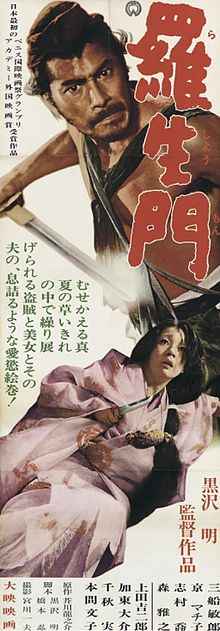
RASHOMON directed by Akira Kurosawa (Japan, 1950)

When hearing testimony in criminal cases, the judge and jury always have to keep an open mind. The need to save face, guilt, shame or simply a bad memory are all reasons why the accounts of eye witnesses may not be as reliable as they first seem. What passes as an indisputable truth is often merely one person’s word against another.

Kurosawa’s cinematic masterpiece illustrates this with a poetic and brilliantly realised presentation of the killing of a samurai as seen from four different points of view.

The film opens during a violent storm with a woodcutter and a priest sheltering from heavy rain under a partially ruined temple of Rashomon. They are both depressed about  a tragic murder, a killing that makes them despair for the human race. A passing ‘commoner’ joins them and takes a more pragmatic perspective, unable to understand why they should be getting so distressed over the death of just one man.

What follows are four different accounts of how the samurai met his end. All the versions are agreed on what preceded this man’s demise . This is that a bandit (Tajōmaru) takes a shining to a woman journeying through the woods by her husband. He follows the couple, lures hubby away with a cock and bull story about swords for sale (cut price?!) then ties him so that he can have his wicked way with the wife.

In most synopses this is referred to as a rape but it is presented more as an aggressive seduction. She puts up some violent resistance at first but this is followed by passive submission and her clenched hand changing to a caress suggests complicity.

It’s like one of those scenes in Sergio Leone’s spaghetti westerns where the man with no name (Clint Eastwood) beds a girl with no shame even when she initially seems unwilling. In other words, it’s based on the non politically correct premise that “no” means “maybe”.

Tajōmaru’s wild manner and maniacal laughter  either makes him a dubious witness or someone with nothing to lose.

His version of events is actually the most credible. This has it that he chivalrously set the samurai free to fight (a little belatedly!) over the woman’s honour and won out in the ensuing duel.

The woman is distraught and her account is less convincing. She apparently begged for forgiveness but was met only with her husband’s steely accusatory gaze. The guilt and despair forces her to faint with a dagger in her hand. When she come round the dagger is buried in her man’s chest.

The woodcutter disputes this testimony on the basis that the man was killed by a sword. But can he be trusted? Initially he denied having seen anything but then changed his story. Ultimately, he also identifies the killer as the bandit, although he says the duel to the death was a far messier affair with Tajōmaru emerging victorious by good fortune rather than through expert swordsmanship.

The dead samurai gets to give evidence too through the use of scary looking medium who looks like his wife in drag. The way he tells it is that he committed suicide, again with the dagger, as he couldn’t live with the disgrace of his woman having done the nasty with the bandit. This seems the least believable of the four possibilities. For starters, someone would have had to come along afterwards to remove the blade.

However, by the close, there’s nothing to say definitively what really happened. The only thing that’s certain is that the samurai is no more.

The allegorical ending shows a new life substituting the needless death. After the storm abates, an abandoned baby is discovered crying in the temple. The woodcutter offers to take the newborn and this gesture, together with the sight of him gleefully carrying the child in swaddling clothes restore’s the priest’s faith in humanity.

This majestic movie is equal 26th in BFI’s list of best movies of all time and the ‘rashomon effect’ is a term now used to describe the fallibility of perception.

Teaching English pronunciation and spelling is often a thankless task.

All of those soul destroying exceptions tend to make the rules less than golden.

Over the years, I’ve learnt never to say never; as in you should never split infinitives, never use double negatives or never talk about emotions using the ‘-ing’ form of the verb.

TV shows, pop songs or adverts will quickly make a mockery of such statements whether it’s Captain Kirk explaining the Starship Enterprise’s mission “to boldly go”, Mick Jagger bemoaning he “can’t get no satisfaction” or Ronald MacDonald enthusing “I’m loving it”.

The ground is just as slippery when it comes to pronunciation. My dad was fond of quoting George Bernard Shaw’s retort when a woman informed him that ‘sugar’ was the only word in the English language where ‘s’ is pronounced ‘sh’. “Are you sure?” he asked her.

Yet still there’s that fatal temptation to pretend that some rules work so when, in an advanced class today, a student asked me to spell ‘foreigner’ I was glad to oblige and smugly add a mnemonic I learned in primary school which was ‘I before E except after C’. After writing this below the word ‘foreigner’ I immediately realised I’d made an embarrassing gaffe.

Just consider for a moment some of the other exceptions to this spelling rule and tell me if it really serves any educational purpose whatsoever.

You can only grieve for foreign scientists who have to write their theses in English and seize upon weird rules believing they are receiving sound advice only to find them insufficient.

And, while we’re about it  just remember that the M in ‘mnemonic’ is silent – like the D in Django.

NOVEL GAZING

Book maze at Festival Hall, London.

So many books – so little time! Book maze at Festival Hall, London.

I tend to be suspicious of book reviews in general, especially when they appear very soon after the date of publication.

Even if critics have read the tome in question (which I often doubt), I wonder whether they have really had the chance to reflect upon it fully before giving their verdict.

I know that reviewers usually get early copies to allow them more time but, I think I’m right in saying, this was not the case for J.K. Rowling’s The Casual Vacancy.

Obviously, in this case the publisher didn’t have to worry whether or not the book would sell and they also wanted to keep the content as secret as possible before it hit the streets. As a result critics and lesser mortals could start reading on the same date. Even so, the first reviews came out remarkably quickly.

I haven’t read Rowling’s novel myself so I can’t comment on how fair or accurate these early musings are but this situation did make me think of  a column of ‘book notes’ in an old edition of The Idler (issue 19, late summer 1997 to be precise) where each review was followed by a letter coded system, the key to which was as follows:

R = The reviewer read the book in question.

DC – The reviewer just flicked through the opening chapter.

IDTP – The reviewer ignored due to prejudice.

CG – The reviewer decided to sacrifice a proper review in favour of a cheap gag.

In the name of honesty and transparency , wouldn’t it be great if all book reviews in newspapers and magazines were labelled in this way?

THERE’S SOMETHING IN THE WATER!

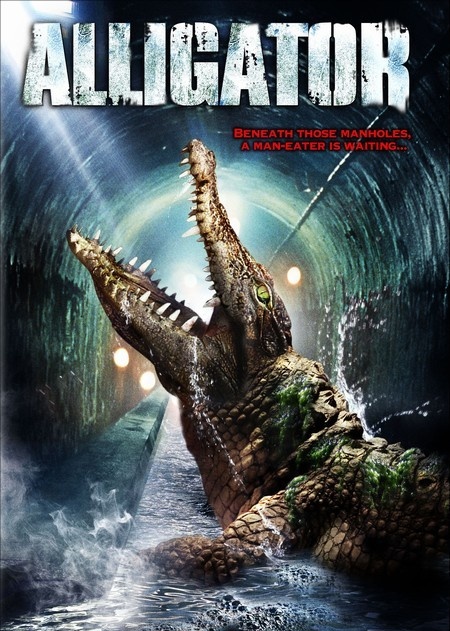
ALLIGATOR directed by Lewis Teague (USA, 1980)

This is the cautionary tale of what happens when a young girl’s baby alligator, Ramón, gets flushed down the toilet by her animal phobic father.

Twelve years later the girl ,Marisa (Robin Riker), has grown up to be an authority on reptiles and her pet Ramón has grown up to become a man-eating monster.

Marisa’s expertise is such that she knows alligators’ natural instinct is to look for water. Seemingly you get a degree in lizard science if you learn such things. What she doesn’t know is that if a baby gator’s diet consists of dead dogs pumped full of experimental hormones they will grow to mega-proportions and terrorise a city.

Bloody limbs in the sewers convince a dim-witted St Louis police squad that there’s something in the water. David Madison (Robert Forster) is the stressed cop with bad hair assigned to the task of going down the drains. Continue reading