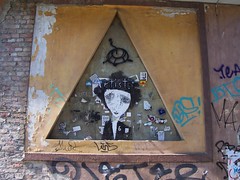
ZOO CITY by Lauren Beukes (Angry Robot, 2010).
 This novel won the 2011 Arthur C. Clarke Award for the best work of Science Fiction published in Britain. Joey HiFi also won the best cover art award at the British Science Fiction Association Awards. Lauren Beukes is a white South African author who was a freelance journalist for ten years.
Like so much of recent Sci-Fi, Beukes doesn’t need to invent a futuristic setting – the noughties have enough strangeness, tension and technology to fuel any half way decent story. So, when she writes of the fascination with the trappings of fame where “even vague proximity to celebrity turns people into attention whores, especially teenagers”, it is clear that this is our present day world.
Although Beukes lives in Cape Town, the fictional events take place in Johannesburg which is portrayed as “cheap knock-off” city where drugs.poverty and criminality are a way of life. The Zoo City of the title is a kind of quarantine camp in that it is a heavily policed claustrophobic urban zone. Criminals are forced to carry animals as what the central character, Zinzi December, describes as “the physical manifestation of our sin”. This establishes an artificial and visible divide between the ‘good’ citizens and the transgressors and is akin to the idea of having somewhere wearing a placard detailing what crime they have committed.
Zinzi. who was ‘animalled’ with a sloth in 2006, describes herself as “an outrageously inexpensive indie boutique kinda girl” who finds barbed wire and broken windows comforting. She has the ability to trace lost objects and ekes out a hand-to-mouth income by getting money for finding things for people (often playing an active role in losing the items in the first place!).
The sprawling plot is rooted in a shady deal in which she is her assigned to find Songweza, a singer who is one half of a teeny-bop duo (a “nu-’80s mod rocker”).
Beukes’ writing style is, like her sassy heroine, “counter-culture aspirational” in which he uses her journalistic experience to explore underground club scenes and rehab centres. She combines elements of hard-boiled crime fiction with Cyberpunk attitude.
Although it is set in South Africa race never specifically an issue; Zinzi is called a “darkie girl” but people are not identified by skin colour. The dysfunctional society is more a product of a gulf between the haves and the have-nots.
While Beukes relishes every chance to use snappy wise-cracks, these are used self-consciously and her writing is too often weighed down by peripheral details. Take, for example, this description of Zinzi’s first visit to the Haven rehab centre: “She opens the door into a spacious lounge with chairs arranged in a loose arc, facing a huge open fireplace – big enough to cook children in. Above the mantelpiece is a mounted Perspex light, featuring a naive drawing of a cocky gentleman devil smoking a pipe, reclining in an armchair. On the opposite wall is a dreamy etching of a goat with its head bowed and a chain around its neck”. The menacing fireplace, cocky gentleman and dreamy goat are all good images but throwing all three together makes the text too heavy – it drags along when it should be flying.
Another irritant, at least for me, was the amount of Africana words that pepper the text. Either there should have been a glossary or these should have been used more sparingly. Here’s an example: “Hayibo, sisi. So cynical and you with a shavi.…..my dlozi says you will need a reading. The amathambo will help you”.
I really wanted to like this book but found that half way through I hit a kind of dead-end. While the premise is intriguing, Beukes doesn’t back it up with a tight plot or people the fiction with characters I could care about. It could have been brilliant but ends up being so-so.