


“Andy Warhol was replicating images to show they were meaningless, and now, thanks to Mr Brainwash, they’re definitely meaningless.” – Banksy
Is Thierry Guetta for real? As Mister Brainwash (MBW) he has mounted a succesful shows in LA (Life Is Beautiful) and NYC (Animal New York) and was commissioned to do the cover art to Madonna’s album Celebration.
Guetta plays the starring role Banksy’s documentary (prankumentary?) Exit Through The Gift Shop billed as ‘the world’s first street art disaster movie’.
 First and foremost , he is a man with a video camera who films everything that moves. This might be a toilet flushing, a family meal, pranks on customers in his second-hand clothing store or star spotting (including a very pissed off looking Noel Gallagher).
There is no method in this madness until he stumbles upon the work of street art by chance. His cousin, aka Space Invader, introduces him to a nocturnal subculture of these guerrilla graffitti artists who take to the streets at night to leave their mark armed with spray cans stencils and varying degrees of artistic talent.
This anarchic world hooks Guetta and gives his filming a purpose. He tells anyone who asks that he is making a documentary but after finishing each film he stashes the spools away in boxes unwatched and often unlabeled. The way he tells it, it’s the buzz of capturing something on tape that feeds his addiction.
He befriends Shepard Fairey and we see the two putting up Fairey’s Orwellian OBEY posters.
Guetta’s tenuous command of the English language and borderline sanity makes him appear as a bumbling Poirot type character. It is his apparent naivety that makes him less threatening. He doesn’t come across as someone who is setting out to exploit his subjects.
On getting to know the work of street artists, the one illusive figure he hasn’t tracked down is Banksy who, unlike Fairey, goes to great lengths to preserve his anonymity. It is through Fairey that he gets a chance to meet the man behind the enigma. Such is his hero worship that Guetta puts himself entirely at Banksy’s disposal and drives hime to prime locations in LA where his work can be ‘exhibited’ .
Banksy’s terms are that he must always be filmed so that his face is not visible and he gets to check the films after each recording. (In this movie Banksy only appears as a hooded figure in the shadows and his speaking voice is digitally distorted).
When asked to produce the finished documentary from all his films, Guetta edits an unwatchable movie that seems tailored for viewers with an attention span of thirty seconds.
Up to this point, the story seems improbable but believable.
Then the focus shifts as Guetta becomes not just a voyeur but an artist in his own right. Following Banksy’s advice to put all he has learnt from observing artists at work into practice, he devotes all his time, energy and money into a massive exhibition in LA using Banksy’s highly successful Barely Legal show as a model.
 What is patently obvious is that Guetta’s artistic abilities are highly limited or even non-existent. We never see him producing any ‘art’ himself. He employs a team to produce the works which brazenly copy ideas of Andy Warhol and Banksy himself.
The likelihood is that the whole Guetta story is a fiction, but if it is no-one is letting on. The reviewer for Pop Matters put it well when he wrote that the film’s true motive is “to gauge whether the audience can tell the difference between something beautiful yet risen from the street or something only made to appear as such”.
Hoax or not, the movie is very effective in exposing the absurdity of wealthy collectors with more money than sense scrabbling desperately to invest in the next big thing and willing to risk shelling out for what may later prove to be another line of emperor’s new clothes.
Related Articles
- Banksy Makes The Simpsons Funny Again [Video] (gawker.com)
- Banksy film wins documentary gong (bbc.co.uk)
- Banksy tags the Segregation wall in Palestine. (Brian Sewell Art Directory)


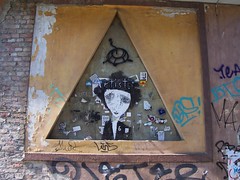
Awesome movie, if you’re into streetart, it’s definately worth the watch. Thierry is a genius and uses Banksy and Shepard to pull off his show and make a new name for himself.