Tag Archive: rom-coms


SEX, LIES AND VIDEOTAPE directed by Steven Soderberg (USA, 1989)

sex & lies“All life is sex. All sex is competition”. James Spader’s line comes from a cameo appearance the US sitcom The Office but could easily stand as a tagline for his captivating lead performance as Graham Dalton in Sex, Lies And Videotape.

This independent movie had a huge impact when it was first released and watching it again , almost three decades on, I was struck about how it still holds up for its bravery, integrity and originality.

The themes of sexuality, fidelity and gender politics remain as relevant now as they did in 1989. Indeed, these issues are arguably even more significant in the wake of the plethora of #metoo related stories and Trump’s brazen capacity for lying. Digital technology would now replace videotape but everything else about the story rings true.

The film deals with the notoriously delicate topic of sex with a liberating degree of frankness and maturity. This is all the more remarkable given that Soderberg was only 26 when he wrote and directed it. He’s made some decent movies since but the audacity and boldness of youth still makes his debut his best work.

Significantly, there are no explicit sex scenes. Soderbach’s stated aim was that of challenging mainstream audiences with ideas rather than with nudity. Continue reading
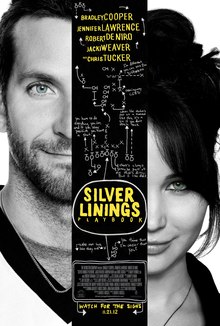
SILVER LININGS PLAYBOOK directed by David O.Russell (USA, 2012)

After the sobering experience of watching Indonesian death squad leaders giving tips on how to kill communists in The Act Of Killing, I needed some light relief.

How about a nice Rom-Com?

I was cognizant of the fact that many films in this genre are simply not funny and most are plain dumb. Silver Linings Playbook, liberally adapted from a novel by Matthew Quick, is a welcome exception to this rule. It not only has a heart and soul but has a brain too.

The movie boasts a top class double act in the form of Bradley Cooper as Pat and Jennifer Lawrence as Tiffany. Both have a history of mental instability and possess bags of energy but poor social skills – “I don’t have a filter when I talk” says Pat, who suffers from bipolar disorder.

Tiffany, a self-proclaimed “ex-slut” is convinced that “humanity is just nasty and there’s no silver lining”. Pat, whose motto is ‘excelsior’, believes that if you get in shape and stay positive, the breaks will come. Continue reading

AMÉLIE’S FABULOUS DESTINY

The fact that Le Fabuleux Destin d’Amélie Poulain is generally billed as a whimsical, French romantic-comedy is why it has taken me so long to see it. Whimsy is usually another word for cheesy, French often means pretentiously arty and rom-coms are mostly crap.

Thankfully, this charming movie made in 2001 proved me wrong on all three counts. It is a little over long but Audrey Tautou in the title role is so cute and watchable that this is not a major hardship.

She plays a shy waitress who starts a personal programme of anonymous good deeds to compensate for her feelings of loneliness. As a “Madonna of the unloved”  she seems resigned to not finding love or happiness in her own life.

Of course, this changes when she becomes intrigued by a man whose bizarre hobby is collecting discarded pictures from public photo booths. This cranky pastime, together with the fact that he works in a porn shop and on a ghost train convinces her that she’s found a man who is a weird as she is. She contrives an elaborate game of cat and mouse before they finally meet face to face and their mutual attraction is confirmed.

All this is, indeed, whimsical and the Parisian setting and characters are very French (an English movie would have had more of a cynical edge to it).  But it won my heart because there’s such a genuine affection and compassion for the routines and obsessions of all the lonely people. The movie’s eccentric humour is brought to life by Jean-Pierre Jeunet’s original direction and Yann Tiersen’s vivacious score.

One of the key roles is that of a reclusive old man who lives within spying distance of Amélie. He spends his days painting copies of Renoir’s ‘Le déjeuner des canotiers’ and complains of the difficulty in capturing the image of one figure in the painting of a young girl drinking a glass of water. She is “in the middle but outside” he says; a description that also sums up Amèlie’s life until she overcomes her natural timidity and starts to engage with the real world rather than living in the realm of fantasy.

A lovely movie.